

AI chatbots are no longer a novelty or a cost-cutting experiment. They are now handling the majority of customer support interactions at some of the world's largest consumer brands - and increasingly, at small and mid-sized businesses too.
The question is no longer whether AI can help. The question is: which tasks are actually worth automating, and which still need a human?
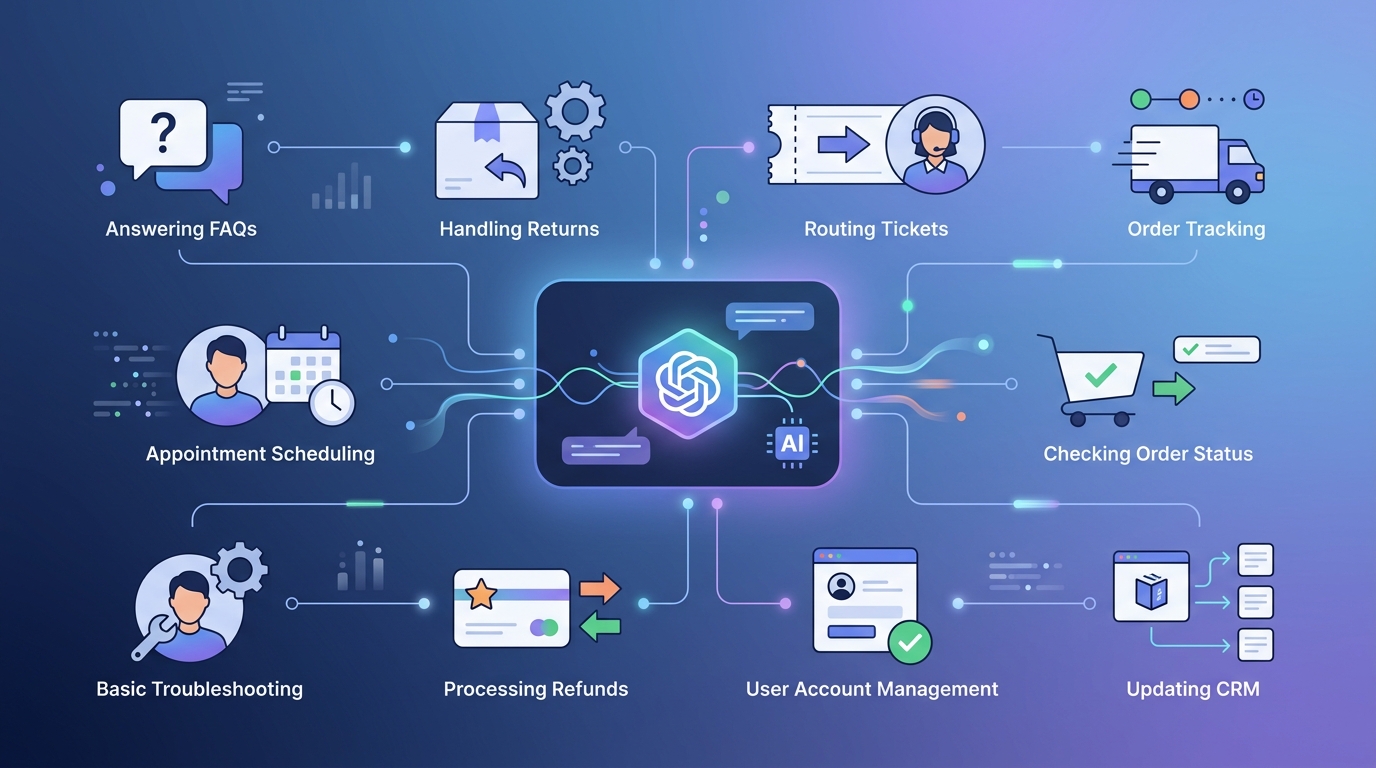
This guide covers the 10 customer support functions that AI chatbots handle most effectively today, backed by current performance data and grounded in what actually works in production.
The Numbers Behind AI Support Automation
Before getting into the tasks themselves, a few figures establish the scale of what is possible:
- AI now resolves 65% of incoming support queries without human intervention, up from 52% in 2023
- The average cost of a human-handled support interaction runs $8-15 per ticket (fully loaded). AI handles the equivalent for $0.25-2.00
- Klarna's AI assistant handled 2.3 million conversations in its first month - equivalent to 700 full-time agents - and resolved issues in under 2 minutes vs. 11 minutes for human agents
- Businesses using chatbots report average annual savings of $300,000 and a 30% reduction in support costs
- AI reduces first response times from over 6 hours to under 4 minutes
These outcomes are not theoretical. They are happening at businesses across e-commerce, SaaS, banking, healthcare, and consumer services. Here is where the gains come from.
1. Answering Frequently Asked Questions
This is the highest-volume, lowest-complexity category in almost every business. Pricing questions, return policies, shipping windows, store hours, cancellation terms - the same 15-20 questions arrive hundreds of times a month, and the answer is the same every time.
AI chatbots are purpose-built for this. A well-trained bot with a current knowledge base can resolve these questions instantly, 24/7, without escalation.
What the data shows:
- 80% of routine inquiries can be managed by AI without human involvement
- The top 20 most common questions typically account for 40-60% of total ticket volume
- Companies see average returns of $3.50 for every $1 invested in AI customer service, with FAQ deflection as the primary driver
Where it breaks down: When policies change and the knowledge base is not updated, the bot gives wrong answers. This erodes trust faster than a slow human response would. Knowledge base maintenance is the operational discipline that determines whether FAQ automation works long-term.
2. Order Tracking and Shipping Status
"Where is my order?" is the single most common customer service query in e-commerce. It is also the most automatable - provided the chatbot is integrated with the order management system and shipping carrier APIs.
A connected chatbot can pull live order status, estimated delivery date, tracking number, and carrier name without involving a human. It can also detect anomalies (no scan in 48 hours) and preemptively notify customers before they have to ask.
What the data shows:
- 39% of all customer-business chats in e-commerce are already managed by chatbots
- Chatbot-led order tracking sees up to a 30% increase in self-service resolution for e-commerce businesses
- 80% of e-commerce businesses are expected to have deployed chatbots for this purpose by 2025
Where it breaks down: When shipments are genuinely lost or significantly delayed, customers are frustrated. A chatbot that says "Your package is in transit" for the sixth day in a row reads as incompetent. Orders with active problems need human judgment and empathy - the bot's job is to handle routine status checks, not damage control.
3. Appointment Scheduling and Booking
For service businesses, healthcare providers, consultants, and any company that operates on a calendar, booking management is a high-volume, repetitive task ideally suited to automation.
AI chatbots integrated with scheduling tools (Google Calendar, Calendly, Cal.com, or EHR systems) can book, reschedule, and cancel appointments without any human involvement. They can check availability in real time, send confirmations, and follow up with reminders.
What the data shows:
- AI appointment scheduling automates 95% of booking requests at businesses that deploy it fully
- Medbelle saw a 60% boost in scheduling efficiency and 2.5x more booked appointments after deploying a booking chatbot
- Weill Cornell Medicine reported a 47% increase in digitally booked appointments post-deployment
- Typical ROI: $48,000/year saved with a 3.2-month payback period
Where it breaks down: Multi-resource scheduling (rooms, staff, equipment combinations) can exceed the logic most chatbots handle well. Healthcare scheduling specifically requires HIPAA-compliant infrastructure - not all chatbot platforms are certified for this.
4. Lead Qualification and Sales Handoff
Most website visitors who interact with a chat widget are not ready to buy - but some are. An AI chatbot can ask the right qualifying questions (company size, use case, budget range, timeline), score the lead, and route hot prospects to a sales rep immediately - or book a demo automatically.
This converts a passive contact form into an active qualification engine, running continuously without SDR headcount.
What the data shows:
- Lead qualification time drops 61% with automated chat workflows
- Websites with AI chatbots see 23% higher conversion rates than those without
- 26% of all sales at companies using chatbots begin with a chatbot interaction
- Chatbot-led funnels convert 2.4x higher than traditional web forms
Where it breaks down: Aggressive qualification flows backfire when they feel like interrogations. Enterprise buyers - particularly in B2B - resist being processed by a bot before speaking to a human. The qualification flow needs to be designed for the customer's psychology, not just internal CRM requirements.
5. Password Resets and Account Management
Password resets alone account for 30-50% of all IT helpdesk requests at most organizations. When each manual reset costs $70+ in lost productivity and agent time, the automation case is straightforward.
AI chatbots integrated with identity providers can verify user identity (via email OTP, SMS, or security questions) and trigger self-service account recovery without human involvement. The same logic extends to plan changes, preference updates, and profile management.
What the data shows:
- One healthcare platform saved $22,000/month immediately post-launch by automating 89% of password reset requests
- AI achieves ticket deflection rates of 40-85% for account management tasks at SaaS companies
- Gartner: AI-first support platforms see 60% higher ticket deflection and 40% faster response times vs. traditional help desks
Where it breaks down: Account lockouts flagged for potential fraud cannot be safely resolved by an AI. Any account action that could expose sensitive data or financial records requires human review with proper verification protocols.
6. Returns, Refunds, and Cancellations
Return and refund processing is time-intensive, policy-dependent, and emotionally charged. It is also highly scriptable when the customer's situation fits within standard policy parameters - which most do.
A chatbot can check order eligibility, walk the customer through the return process step by step, generate a prepaid label, and initiate the refund - automatically. This deflects a large volume of routine requests from human agents who can then focus on complex or disputed cases.
What the data shows:
- Requests requiring human intervention dropped 42-66% with return chatbot automation
- Refund handling time fell by 40-60% in implementations with well-designed return flows
- Refunds issued unexpectedly actually decreased by 13-28% - because a guided chatbot flow clarified policy before customers requested them, deflecting unnecessary refund demands
Where it breaks down: Disputed refunds, partial returns, and fraud-suspected transactions require judgment that AI should not make autonomously. Physical return logistics also require integration with warehouse and carrier systems - the chatbot handles the customer conversation, but the backend plumbing is substantial.
7. Ticket Triage, Tagging, and Intelligent Routing
For businesses receiving hundreds or thousands of tickets per day across multiple channels, manual triage is a bottleneck. AI can read incoming messages, classify by intent and urgency, tag by topic and product area, and route to the correct queue or agent - automatically and consistently.
This is not just cost reduction. Accurate routing means the right person handles each ticket from the start, reducing resolution time and the handoffs that frustrate customers.
What the data shows:
- AI-driven routing achieved 30% faster average response time vs. manual triage
- Support teams using AI triage reduced resolution times by 28% on average
- One B2B SaaS company grew its AI resolution rate from below 30% to nearly 50% of incoming chats after deploying AI triage
- Brands with proactive AI assistants deflected up to 35% of inbound tickets before they reached a human
Where it breaks down: Misrouted tickets create frustration and delay. Early-stage implementations with insufficient training data will misclassify tickets at meaningful rates. The system requires a calibration period and ongoing quality review before fully replacing manual triage.
8. Proactive Upselling and Cross-Selling
Support interactions are also commercial opportunities - when they are handled thoughtfully. An AI chatbot that has resolved a customer's question can recommend a relevant add-on, flag a discount on a complementary product, or surface an upgrade at a moment of high engagement.
This is categorically different from cold promotional messaging. Context-aware recommendations during active sessions convert at materially higher rates.
What the data shows:
- Businesses using AI chatbots report 15-25% increases in cross-sell revenue
- Order bump upsells via chatbot show a 37.8% conversion rate
- 12.3% of shoppers who use AI chat convert, vs. 3.1% without - a 4x lift
- AI-driven proactive chats recover 35% of abandoned carts
Where it breaks down: Upselling during a complaint interaction is a fast way to lose a customer permanently. Recommendations require CRM and purchase history integration to avoid being generic. Poorly timed or irrelevant suggestions reduce trust and increase opt-out rates.
9. Customer Onboarding and Product Education
New user onboarding is one of the highest-leverage support functions in SaaS and digital products. Most churn happens in the first 30 days, and much of it is preventable with timely, contextual guidance.
AI chatbots embedded in the product can walk new users through setup, surface relevant features based on their use case, answer how-to questions without documentation search, and check in proactively at key friction points.
What the data shows:
- 68% of healthcare organizations now use chatbots for patient onboarding in addition to scheduling
- 83% of e-commerce companies use chatbots for support and sales
- 85% of customer service leaders planned to pilot generative AI for onboarding use cases in 2025
- Companies implementing AI-assisted onboarding see measurable reductions in first-30-day support ticket volume
Where it breaks down: Complex product onboarding cannot replace a hands-on demo or a dedicated customer success manager for high-value accounts. Onboarding chatbot scripts become stale as products update - the maintenance requirement is ongoing. Low-digital-literacy users may disengage with a chatbot flow when they need a patient human instead.
10. Post-Interaction Feedback Collection (CSAT and NPS)
Getting feedback from customers after a support interaction is standard practice, but email survey response rates are low (6-15%) and often biased toward extremely satisfied or extremely dissatisfied respondents.
AI chatbots collect feedback in-context - immediately after the interaction, within the same channel - which produces meaningfully higher response rates and more representative data. They can also route low-score responses to a human for recovery before the customer churns.
What the data shows:
- In-app chatbot CSAT surveys achieve 20-27% response rates, vs. 6-15% for email
- SMS-based automated surveys reach 40-50% response rates
- AI achieves a 27% CSAT improvement through AI-powered personalization (Freshworks)
- Zoom achieved a 19-point CSAT increase (from 55% to 74%) after deploying AI in customer service
- Companies using AI in customer interactions saw a 22.3% jump in satisfaction scores
Where it breaks down: Over-automation of feedback requests produces survey fatigue and declining response rates. Negative feedback collected by a bot is only valuable if it triggers a real human response. The loop must close with action, not just data collection.
A Comparison Table
| Task | Automation Potential | Integration Required | Complexity |
|---|---|---|---|
| FAQ Handling | Very High (80%+) | Knowledge base | Low |
| Order Tracking | High (70%+) | OMS + carrier APIs | Medium |
| Appointment Booking | High (95%) | Calendar/EHR | Medium |
| Lead Qualification | High | CRM | Medium |
| Password Resets | High (85%+) | IdP (Okta, Auth0) | Low-Medium |
| Returns and Refunds | High (60%+) | OMS + returns system | Medium |
| Ticket Triage | High (80%+) | Help desk platform | Medium |
| Upselling | Medium | CRM + catalog | High |
| Onboarding | Medium | Product analytics | High |
| CSAT Collection | High | Chat + CRM | Low |
What Not to Automate
AI chatbots are excellent at tasks that are high-volume, predictable, and well-bounded by policy. They fail - sometimes badly - at:
- Complex, multi-part problems with dependencies across systems
- Emotionally charged escalations (lost shipments, billing disputes, cancellation winbacks)
- Cases where context from prior interactions requires human judgment to interpret
- Situations that require flexibility, judgment, or deviation from standard policy
The businesses that get the most value from AI do not try to automate everything. They draw a clear line: the AI handles what it handles well, with a reliable escalation path to a human when it does not.
75% of basic AI chatbots fail at complex customer issues - and when they do, the customer's trust in the brand drops faster than if there had been no bot at all.
Getting Started
Automation does not require a complete overhaul of your support infrastructure. The highest-ROI starting point is almost always FAQ deflection - identify the 15-20 questions your team answers most frequently, build accurate answers into a chatbot knowledge base, and measure deflection rates over 30-60 days.
From there, the roadmap is visible: add order tracking, connect your booking calendar, set up lead routing. Each integration extends the automation surface while keeping humans available for the cases that need them.
Paperchat makes this process straightforward - you train the bot on your existing content, embed the widget, and start measuring. The improvements compound as the knowledge base grows and the routing logic matures.
More Articles
How to Automate Customer Support Without Losing the Human Touch
The practical guide to using AI chatbots for customer support in a way that feels helpful, not cold — including when to hand off to a human.
March 29, 2026
How to Set Up AI-to-Human Handover in Your Customer Support Chat
A practical guide to configuring seamless handoff from your AI chatbot to a live agent — so no customer ever hits a dead end.
March 29, 2026