

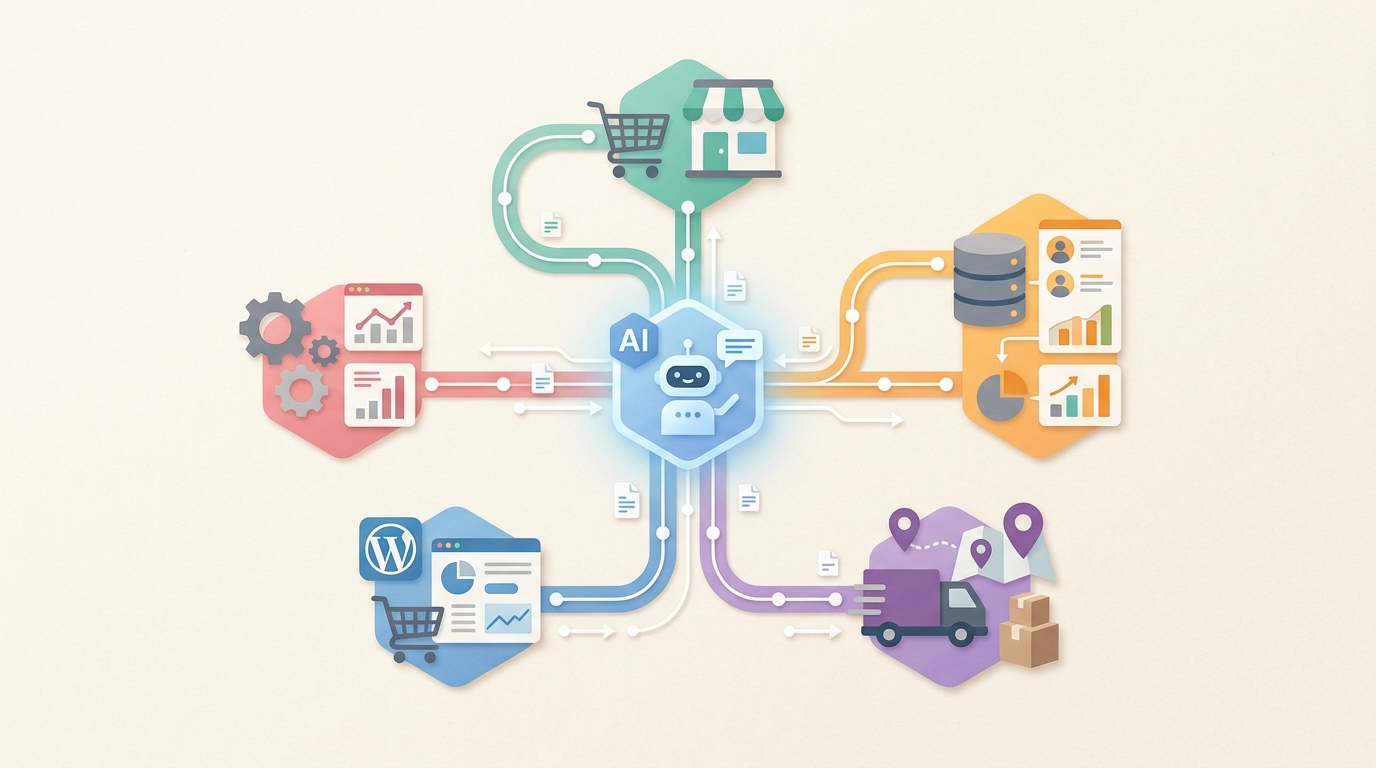
An AI chatbot on its own is a widget. An AI chatbot connected to your e-commerce stack is a revenue and retention engine.
The difference is integration. A chatbot that can only answer questions from a static knowledge base deflects some tickets and answers some FAQs. A chatbot connected to your store platform, CRM, shipping provider, and automation layer can confirm order status in real time, recover abandoned carts, qualify leads, trigger marketing sequences, and escalate to a human agent with the full purchase history already loaded.
This guide covers the five integrations that deliver the most measurable impact for e-commerce stores in 2026 - with current performance benchmarks, setup complexity assessments, and case study data from real deployments.
Why Integration Depth Determines Chatbot ROI
Before examining specific integrations, the market context for AI chatbot adoption in e-commerce is worth establishing:
- 77% of e-commerce professionals use AI daily in 2025, up from 69% in 2024 (EComposer)
- Gartner projects 75% of all online shopping interactions will involve AI-driven conversation by 2026
- Shoppers assisted by AI chatbots convert at 12.3% vs. 3.1% without - a 4x lift
- AI chatbots deliver an average 340% ROI in the first year, with payback in 3-6 months
- CRM integrations alone deliver $8.71 for every $1 spent; combined chatbot + CRM ROI ranges from 350% to 1000%+
- Cart abandonment currently runs at 75.38% - the ceiling of value available for recovery
The ROI case for AI chatbots in e-commerce is strong. The variance between implementations - some seeing minimal impact, others generating dramatic conversion lifts - comes down almost entirely to how deeply the chatbot is wired into the surrounding systems.
The five integrations that follow are sequenced by the stage of the customer journey they most affect: discovery and conversion, order management and post-purchase, automation fabric, CRM and retention, and the emerging agentic commerce layer.
1. Store Platform Integration (Shopify and WooCommerce)
The most fundamental e-commerce chatbot integration is with the store platform itself. Without it, a chatbot cannot confirm real-time inventory, look up order status, surface personalized product recommendations, or take cart actions during a conversation. With it, all of these become standard capabilities.
Shopify
Shopify's App Store now treats AI chatbot integration as a first-class capability, with a range of platforms offering native OAuth-based connections that pull live product data, pricing, inventory levels, and order records without custom development.
Key capabilities enabled by Shopify integration:
- Real-time inventory and pricing confirmation during chat
- Order status and tracking number lookup - the most common customer question in e-commerce
- In-chat cart actions: add products, apply discount codes, initiate checkout
- Return and refund eligibility checking against order history
- Personalized product recommendations based on browse and purchase history
- Agent actions (via platforms like Gorgias): cancel orders, update shipping addresses, remove items - without human involvement
What the data shows:
- "Where is my order?" accounts for up to 40% of all inbound support inquiries at e-commerce stores
- AI chatbots reduce these WISMO (where is my order) tickets by 30-50% with basic Shopify integration; up to 60-80% with proactive tracking notifications
- Stores with AI chatbot product recommendation engines see 15-35% conversion lifts
- AI increases Shopify conversion rate by approximately 7% in independent analysis (2026)
- Amazon generates 35% of sales from AI recommendations - the product recommendation benchmark
- Chatbots recover 35% of abandoned carts through proactive engagement
Setup complexity: Low
Most Shopify chatbot integrations install via the App Store with one-click OAuth. Product and order sync is automatic after authorization. Custom conversation flows and AI training on specific policies and product lines typically take 1-3 days.
Platforms to consider: Tidio (free tier available; Lyro AI resolves up to 67% of requests autonomously), Gorgias ($50/month for 350 tickets; purpose-built for e-commerce with native Shopify actions), Smartbot (App Store native, unlimited AI chat).
WooCommerce
WooCommerce stores run on WordPress, which means chatbot integration is plugin-based. The ecosystem has matured significantly: several platforms now offer WooCommerce-native AI chatbots that sync product catalogs automatically, handle order lookups via the WooCommerce REST API, and capture leads directly into CRM.
What the data shows:
- 15% of WooCommerce stores were using AI chatbots in 2024 (712,000+ stores); projected to reach 20% (935,000 stores) in 2025
- WooCommerce stores using AI chatbots report 45% fewer support tickets
- WooCommerce-native chatbots achieve 95% automation rates on routine queries (Amio, 2026)
- Return and refund inquiries represent 10-15% of orders in apparel and home goods - a prime automation target
Setup complexity: Low-Medium
Plugin installation from the WordPress dashboard is straightforward. The REST API connection for order data requires WooCommerce API keys. Product training auto-syncs from the WooCommerce catalog. Time to production typically runs 1-5 days depending on catalog size and custom policies.
Platforms to consider: Amaya Chatbot AI (GPT PRO - first AI chatbot built specifically for WooCommerce), WoowBot Pro (supports OpenAI + Dialogflow), eesel AI (WooCommerce-native with knowledge base sync), Chat Data (WooCommerce-specific).
2. Shipping and Order Management (AfterShip and ShipStation)
If store platform integration addresses the question "where is my order?", shipping integrations address the follow-up: "why is it late?" and "what happens now?"
Order tracking is the single highest-volume support category in e-commerce. It is also among the most automatable, because the answer is data retrieval - no judgment required, no policy interpretation needed, no emotional complexity. The chatbot queries the shipping API and reports what it finds.
AfterShip
AfterShip is the dominant post-purchase tracking platform in e-commerce, with 17,000+ paid customers, 1,126+ carrier integrations, and 4.4 billion shipments tracked. Its chatbot integration layer lets AI assistants pull live tracking data and answer shipping status questions without any human involvement.
Key capabilities:
- Real-time shipment status pulled from 1,126+ carriers, surfaced within chat
- Predictive delivery dates (AfterShip Premium), giving accurate ETAs rather than carrier windows
- Proactive shipment notifications that surface issues before customers have to ask
- Product recommendations on tracking pages - monetizing a high-engagement touchpoint
- AI-powered anomaly detection: flags shipments that have gone silent for human review
What the data shows:
- Shoppers check order status 3-4 times per order on average - each interaction is a re-engagement opportunity
- Tracking emails generate 50% higher open rates than marketing emails
- AI-generated product recommendations on tracking pages deliver a 1-4% revenue lift
- A fashion retailer using AI chatbot + AfterShip integration achieved a 77% reduction in delivery-related support tickets
- "Where is my order?" accounts for 20-35% of all inbound support messages; AI resolves these without creating a ticket
ShipStation
ShipStation handles fulfillment workflow - carrier selection, rate shopping, label printing - and integrates with AfterShip for tracking. The relevant chatbot integration use case is order data access: a chatbot connected to ShipStation can confirm which carrier is handling an order, when it shipped, and the current status from the carrier's last scan.
Setup complexity: Low-Medium
AfterShip has documented APIs and webhooks. Connecting an AI chatbot to AfterShip requires API configuration rather than plugin installation, but most chatbot platforms have pre-built AfterShip connectors. ShipStation integration typically follows a similar pattern. Combined time to production: 2-5 days.
3. Automation Platforms (Zapier, Make, and n8n)
Store platform integration tells the chatbot what is in your store. Shipping integration tells it where orders are. Automation platforms connect the chatbot to everything else - CRM, helpdesk, email marketing, Slack, spreadsheets, and 5,000+ other tools - without custom development.
This is the integration layer that converts the chatbot from a customer-facing tool into an orchestration point for the business.
Common E-Commerce Automation Workflows
| Trigger | Automation | Outcome |
|---|---|---|
| Lead captured in chat | Add to HubSpot → trigger welcome email | Lead enters nurture sequence instantly |
| Conversation escalated | Create Zendesk ticket → alert agent on Slack | Human context-loaded and ready |
| Cart abandoned (detected in chat) | Trigger Klaviyo abandoned cart flow | Recovery sequence starts immediately |
| Order status requested after hours | Fetch from Shopify API → reply with tracking | No human needed, no wait time |
| New conversation started | Log to Google Sheets | Weekly analytics aggregated automatically |
Zapier
Zapier is the most accessible automation platform, with 8,000+ app integrations and a visual no-code builder. Zapier Agents (2025) adds autonomous multi-step task execution. Zapier Copilot builds automations from plain-language descriptions.
Pricing: Free (100 tasks/month), Starter $19.99/month, Professional $49/month.
Best for: Non-technical teams wanting fast time-to-value with minimal setup.
Make (formerly Integromat)
Make's visual canvas supports branching, looping, filtering, and conditional routing - making it better suited than Zapier for multi-step workflows with complex logic. Its Maia AI assistant builds scenarios from natural language descriptions.
Pricing: Free (1,000 ops/month), Core $9/month, Pro $16/month.
Best for: Operations teams and semi-technical users needing complex multi-branch workflows.
n8n
n8n is self-hostable (fair-code license) with 400+ integrations and 70+ LangChain nodes for custom AI agent pipelines. At scale, self-hosting eliminates per-execution costs entirely while keeping data within your own infrastructure.
Real case study: A 500+ orders/month e-commerce store automated order inquiry handling using n8n. Results: 80% of order-related inquiries automated, average response time reduced from 2 hours to 8 seconds.
Pricing: Community edition free (self-hosted); Cloud from $20/month.
Best for: Technical teams, developers, businesses needing custom AI pipelines or data residency control.
Platforms like Paperchat expose webhook events for every significant chatbot action - new conversation, lead captured, escalation triggered, conversation closed - which makes the Zapier/Make/n8n layer immediately functional: each event becomes a trigger for whatever downstream workflow the business needs.
4. CRM and Email Marketing (HubSpot and Klaviyo)
Acquisition is expensive. Retention is where e-commerce margin lives. CRM and email marketing integrations connect the chatbot's customer interactions to the systems that drive repeat purchase, loyalty, and lifetime value.
HubSpot
HubSpot is the most common CRM for growth-stage e-commerce businesses, with a free tier and modular paid features. Its AI Breeze Copilot layer (2025) adds chatbot-style CRM interactions, email content generation, and workflow automation.
Key integration use cases:
- Chat leads automatically create contacts and deals in HubSpot
- Conversation data syncs to contact records for full interaction history
- High-intent chat signals (pricing questions, feature comparisons) trigger sales workflow automation
- Negative sentiment in chat triggers a customer success alert in the CRM
What the data shows:
- HubSpot customers report 107% more inbound leads, 35% more deals closed, and 28% faster ticket resolution within 6 months
- AI chatbot + CRM integration ROI: 350% to 1000%+
- Customers interacting with AI chatbots show 25% higher lifetime value due to improved satisfaction and retention
Setup complexity: Medium. Native chatbot widget built into HubSpot CRM. Third-party chatbots connect via webhook. Full workflow automation requires HubSpot Marketing or Sales Hub ($20/month+).
Klaviyo
Klaviyo is purpose-built for e-commerce email and SMS marketing, with native integrations for Shopify and WooCommerce. Its AI features include Flows AI (build automation sequences from plain-language descriptions), subject line optimization, predictive analytics, and AI-optimized send timing (reporting +35% open rates).
The chatbot integration pattern here is direct: the AI captures an email during a chat conversation and immediately triggers the appropriate Klaviyo flow - welcome sequence, abandoned cart recovery, post-purchase upsell, or win-back campaign.
What the data shows:
- Chatbot-connected abandoned cart flows recover 23% more carts than email-only sequences
- AI-driven proactive chat recovers 35% of abandoned carts
- Average cart abandonment: 75.38% in 2025 - the scale of available recovery
- Klaviyo delivers approximately $29 ROI per dollar spent across its customer base
- AI-optimized send timing: +35% average open rates vs. standard scheduling
Setup complexity: Low-Medium. Klaviyo connects to Shopify natively; WooCommerce via plugin. Third-party chatbot connections use webhook or Zapier. Flows AI reduces time to build complex sequences from days to minutes.
5. Agentic Commerce (Stripe)
The four integrations above optimize the existing e-commerce model: customers discover products, add to cart, check out, and receive post-purchase support. The fifth integration represents a structural shift in how AI participates in that process.
In 2025, Stripe launched its Agentic Commerce Suite - a set of infrastructure primitives enabling AI agents to execute transactions on behalf of users, with OpenAI as the initial partner. The first implementation: Shopify merchants can now enable checkout directly inside ChatGPT, powered by Stripe.
What This Changes
Traditional e-commerce requires the customer to leave the conversation and navigate to the store. Agentic commerce inverts this: the transaction happens inside the AI conversation, the chatbot becomes the checkout interface, and Stripe handles payment processing in the background.
What the data shows:
- Edgar Dunn & Co projects AI-driven commerce will grow from $136 billion in 2025 to $1.7 trillion by 2030
- 25% of online sales are projected to originate from AI agent interactions by 2030
- Early Stripe Agentic Commerce adopters include Shopify merchants Glossier, Vuori, Spanx, SKIMS, and retailers Anthropologie and Free People
- PayPal's CEO described agentic commerce as "the biggest transformation since the advent of e-commerce"
What It Requires
Stripe Agentic Commerce is not a plug-in for existing chatbots - it is a payment infrastructure layer that chatbot and e-commerce platforms need to build against. For most e-commerce stores, the near-term implementation path is through Shopify's native support for the Agentic Commerce Protocol (ACP), which is being co-developed by Stripe and OpenAI.
For stores that want to position ahead of this shift, the practical step now is ensuring your AI chatbot is on a platform that is actively integrating with ACP - and that your product catalog, pricing, and inventory data are clean enough to support autonomous transaction processing.
Integration Comparison
| Integration | Setup Complexity | Primary Value | Key Metric | Best For |
|---|---|---|---|---|
| Shopify | Low | Conversion + WISMO deflection | 7% conversion lift | Any Shopify store |
| WooCommerce | Low-Medium | Support automation | 45% fewer tickets | WordPress stores |
| AfterShip / ShipStation | Low-Medium | Post-purchase experience | 77% WISMO reduction | High-volume shippers |
| Zapier / Make / n8n | Low-Medium | Cross-system automation | 80% inquiry automation | Any tech stack |
| HubSpot CRM | Medium | Lead nurture + sales | 107% more leads | Growth-stage stores |
| Klaviyo | Low-Medium | Email/SMS retention | $29 ROI per $1 | Shopify / DTC brands |
| Stripe Agentic Commerce | Medium-High | In-chat transactions | $1.7T market by 2030 | Forward-looking brands |
Where to Start
Not every store needs all seven integrations from day one. The sequencing that produces the fastest ROI for most e-commerce businesses follows the customer's journey:
-
Store platform first. Connect the chatbot to Shopify or WooCommerce so it can answer the questions customers actually ask - order status, inventory, pricing, returns - without requiring a human.
-
Shipping second. Add AfterShip or ShipStation access to handle WISMO queries automatically. Combined with store platform integration, this typically eliminates 30-50% of inbound ticket volume.
-
Automation layer third. Connect via Zapier, Make, or n8n to route chat-captured leads into your CRM, trigger escalation alerts in Slack, and fire abandoned cart sequences in real time.
-
CRM and email fourth. Once leads are flowing into the CRM reliably, build the retention layer: post-purchase sequences, win-back campaigns, and satisfaction-triggered service recovery.
-
Watch agentic commerce. The Stripe + OpenAI agentic commerce infrastructure is early. Stores that are already operating clean, well-integrated chatbots are positioned to adopt it faster when it reaches mainstream availability.
Paperchat connects to all of these systems through its webhook and integration layer - the chatbot trains on your store content, connects to your existing tools, and starts deflecting tickets on day one.
More Articles
How to Set Up a WooCommerce AI Chatbot for Your Online Store
A complete guide to adding Paperchat to your WooCommerce store — covering product questions, order tracking, returns, and cart recovery.
March 29, 2026
How to Connect Your AI Chatbot to Zapier, n8n, and Make
Automate workflows triggered by chat events — send leads to your CRM, notify your team on Slack, create support tickets, and more.
March 29, 2026