
7 Mistakes to Avoid When Training Your AI Chatbot
The difference between a chatbot that builds trust and one that frustrates customers often comes down to training quality. Here are the seven most common mistakes, and how to fix them.

Stan
@stan
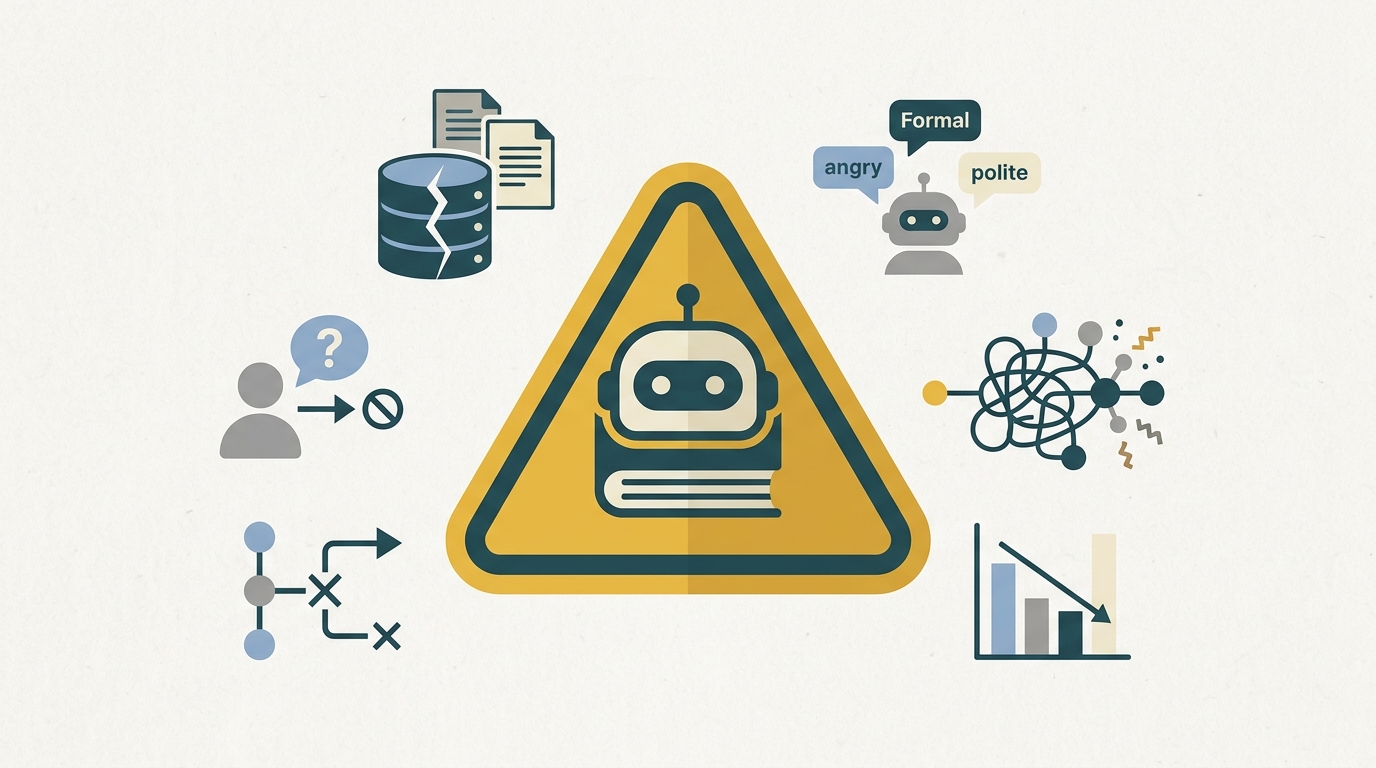
Training an AI chatbot sounds simple in theory: add your business content, configure a few settings, and the bot starts answering questions. In practice, most teams discover that the gap between a deployed chatbot and a useful one comes down almost entirely to training quality.
A poorly trained chatbot does not just fail to help - it actively damages customer trust. It gives confident wrong answers. It misses obvious questions. It escalates conversations unnecessarily. It frustrates users who came to get something done quickly.
The good news is that most training failures are predictable. The same mistakes appear across industries, company sizes, and chatbot platforms. Understanding them in advance is far more efficient than discovering them through poor CSAT scores.
This article covers the seven most common chatbot training mistakes, with the specific failure modes each one produces and the practical steps to avoid or correct them.
Why Training Quality Determines Chatbot Performance
Before examining specific mistakes, the performance stakes are worth quantifying:
- AI chatbots with well-maintained knowledge bases achieve 80-90% deflection rates; poorly trained bots average 25-40% (Alhena.ai, 2025)
- 60% of customers who have a bad chatbot experience will not use that channel again (Freshdesk, 2025)
- Chatbots that provide incorrect information reduce brand trust by 35-40% (PwC consumer survey)
- Organizations that regularly update their chatbot knowledge bases see 15-25% higher first-contact resolution rates
- The single most cited complaint about AI chatbots is "unhelpful or incorrect answers" - cited by 56% of users in post-interaction surveys (Zendesk, 2025)
Training is not a one-time setup step. It is the ongoing operational discipline that determines whether a chatbot remains a trusted resource or becomes a source of friction.
Mistake 1: Training on Outdated or Incomplete Documentation
The most common and most damaging training mistake is using documentation that does not reflect the current state of the business. Pricing that changed three months ago. A returns policy that was updated after a policy review. Features that were deprecated or renamed. A product that was discontinued.
When a chatbot trained on outdated content gives a confident, detailed answer about a pricing tier that no longer exists, the customer does not think "the chatbot was wrong." They think the company was wrong - and they may make purchasing decisions based on incorrect information.
The failure mode:
A customer asks about a feature. The chatbot describes it accurately based on the documentation it was trained on. The feature was removed in the last product release. The customer completes an evaluation, mentions the feature to a sales rep, and discovers it does not exist. The credibility damage is immediate and hard to recover.
How to fix it:
Establish a direct link between your documentation update process and your chatbot training pipeline. Any time product documentation, pricing pages, policies, or feature descriptions are updated, the chatbot knowledge base should be updated in the same workflow - not as an afterthought.
Platforms like Paperchat allow you to sync training data directly from URLs, which means the chatbot can periodically re-ingest your website content and stay aligned with current published information without requiring manual uploads.
Set a minimum review cadence: at minimum, audit your chatbot's core knowledge base every 30 days, and immediately after any significant product or policy change.
Mistake 2: Not Testing with Real Customer Questions
Most chatbot implementations are tested by the internal team using questions the internal team would ask. The problem is that internal teams know the product, know the terminology, and phrase questions the way insiders do.
Customers phrase questions the way outsiders do - differently, often imprecisely, sometimes with incorrect terminology, and frequently without the context that would make the intent obvious.
The failure mode:
A SaaS company trains their chatbot on documentation that uses "workspaces" to describe what customers call "accounts." The chatbot answers questions about workspaces accurately, but fails to recognize the same questions when customers phrase them as "I want to add a second account" or "can I have separate accounts for different clients?" - because "account" does not appear in the training data in the relevant context.
How to fix it:
Collect a sample of real customer questions before deploying. Pull from support ticket archives, chat logs, search queries, and sales call recordings. These are the actual phrasings, vocabulary, and question patterns your customers use - and they are consistently different from what internal teams test with.
After deployment, review chatbot conversations with low confidence scores or escalations weekly for the first 90 days. The escalation log is a direct readout of gaps in training data. Each escalated question that the chatbot could not handle is a training opportunity.
Add alternative phrasings to your knowledge base for high-frequency questions. If customers ask "how do I cancel" and also "how do I end my subscription" and also "how do I close my account," all three should be covered explicitly.
Mistake 3: Ignoring Low-Confidence and Escalated Conversations
Most AI chatbot platforms expose confidence scores for individual responses - a signal of how certain the model is that a given answer correctly addresses the question asked. Low-confidence responses are the chatbot's equivalent of a raised hand: "I am not sure about this, and I may be wrong."
Many teams configure their chatbot, watch it perform adequately in the first week, and then stop monitoring. Low-confidence responses accumulate, wrong answers persist, and the chatbot's performance gradually diverges from what the business actually needs.
The failure mode:
A chatbot answers a pricing question with moderate confidence - not low enough to trigger an escalation, but low enough that the answer is imprecise. It says "pricing starts at $19" when the actual starting price is $29 after a recent change. The wrong answer propagates through every conversation that touches that topic until someone notices and investigates.
How to fix it:
Establish a weekly review process for low-confidence responses and escalated conversations. Most platforms allow filtering by confidence threshold and escalation trigger, making this straightforward to operationalize.
For each pattern of low-confidence responses, add or update the relevant knowledge base content. For each escalation that should not have required a human, add the missing answer. Over the first three to six months of operation, this review loop is the single highest-leverage training activity available.
Set performance benchmarks and track them monthly: deflection rate, escalation rate, confidence score distribution, and CSAT. Divergence from baseline is the signal that training has drifted.
Mistake 4: Training on Too Much Irrelevant Content
The instinct when training a chatbot is to add as much content as possible. More data should mean better answers. In practice, training on large amounts of tangential or irrelevant content dilutes the signal and produces confused, overly broad responses to specific questions.
A support chatbot trained on the full company website - including the investor relations page, the careers section, the historical blog archive, and old product documentation - learns to associate customer questions with a much wider range of content than is actually relevant. The result is answers that technically match some of the training data but miss the specific, accurate response the question requires.
The failure mode:
A customer asks about the current enterprise pricing. The chatbot returns a paragraph that draws from three different sources: the current pricing page, a blog post that mentioned pricing from two years ago, and a case study that referenced a legacy tier. The answer is a blend that does not accurately reflect any of them.
How to fix it:
Be deliberate and surgical about what content goes into the knowledge base. For a customer support chatbot, the core training set should include: current product documentation, current pricing and plans, current policies (returns, cancellations, SLA, privacy), current FAQs, and current feature descriptions.
Exclude: historical blog content, marketing copy that is not directly informative, internal documentation not relevant to customer questions, and any content that references old pricing, deprecated features, or superseded policies.
When in doubt, err toward a smaller, higher-quality knowledge base rather than a larger, noisier one. A chatbot that answers 80% of questions accurately and says "I don't know" on the other 20% is significantly more trustworthy than one that attempts to answer everything with varying degrees of accuracy.
Mistake 5: Neglecting Persona and Tone Configuration
An AI chatbot's knowledge base determines what it knows. Its persona configuration determines how it communicates that knowledge - and tone mismatches erode trust in ways that are subtle but persistent.
A formal, corporate-sounding chatbot on a consumer brand's website feels wrong. A casual, emoji-heavy chatbot on a B2B enterprise platform feels unprofessional. A chatbot that responds identically to an angry complaint and a casual pre-sales question is missing important context signals.
The failure mode:
A direct-to-consumer brand with a playful, conversational brand voice deploys a chatbot with default professional-tone configuration. Customers who are accustomed to the brand's emails, social media, and website voice immediately perceive the chatbot as off-brand - as though a different company had inserted a widget into the site. Engagement drops, and users route around the bot to email support.
How to fix it:
Write an explicit persona brief for the chatbot. It should cover: name and introduction format, tone (formal, conversational, technical, friendly), the language the brand uses and avoids, how to handle frustrated or negative sentiment, and what to do when the question is outside scope.
Test the persona configuration against a set of emotionally varied prompts. How does it respond to "this is ridiculous, your product is broken"? How does it respond to "I just wanted to say your team has been incredibly helpful"? How does it respond to "can you help me decide between plan A and plan B?" The answers to these three types of questions reveal the emotional range and appropriateness of the configuration.
Mistake 6: Not Defining Clear Escalation Logic
AI chatbots should not attempt to handle every conversation. There are categories of questions - legal disputes, complex technical failures, emotionally sensitive situations, high-value account concerns - where AI involvement is inappropriate or counterproductive, and a human agent should take over immediately.
The mistake is either escalating too much (making the chatbot nearly useless, since most conversations route to a human) or too little (allowing the AI to continue in situations where customers are growing increasingly frustrated and a human would have resolved the issue in two exchanges).
The failure mode:
A financial services company deploys a chatbot without escalation triggers for regulatory or compliance questions. A customer asks whether their account is covered by a specific type of insurance protection. The chatbot answers from its knowledge base - which contains marketing materials that mention the protection but does not reflect the specific regulatory scope. The answer is not intentionally wrong, but it is legally sensitive territory that should be handled by a qualified human.
How to fix it:
Define escalation triggers in three categories:
Topic-based: Specific subjects that should always route to a human, regardless of confidence. Examples: billing disputes over a threshold amount, legal or compliance questions, anything involving account security or suspected fraud, medical or health advice, and any question that involves personal safety.
Confidence-based: When the chatbot's confidence score falls below a defined threshold on a substantive question, escalate rather than guess. A low-confidence answer in the wrong direction is worse than an honest "I'm not certain about this - let me connect you with someone who can help."
Sentiment-based: When negative sentiment escalates over the course of a conversation, the appropriate response is human intervention, not another AI reply. Most chatbot platforms support sentiment detection that can trigger escalation when frustration exceeds a threshold.
Mistake 7: Treating Deployment as the End of the Process
The most widespread mistake is structural: treating chatbot training as a project with a completion date rather than an ongoing operational function.
A chatbot trained once and left alone will degrade in relative quality even if the AI itself does not change - because the business around it does. Products evolve. Policies update. New questions emerge from new customer segments, new marketing campaigns, and new competitive dynamics. A static knowledge base falls further behind with every change the business makes.
The failure mode:
A company launches a chatbot in January with excellent training data. By June, they have launched two new products, changed their pricing structure, updated their returns policy, and run a major promotional campaign that generated new customer segments with new questions. The chatbot is still answering based on January's data, generating escalations on questions it could easily handle with updated training, and wrong answers on others.
How to fix it:
Build chatbot maintenance into the regular operational cadence, not as a standalone project. The specific operational activities:
Monthly: Review low-confidence and escalated conversations. Identify patterns. Update knowledge base to address gaps. Verify that pricing, plans, and policies in the knowledge base match current published information.
At product or policy changes: Immediately update the relevant knowledge base sections. Treat this with the same urgency as updating the website.
Quarterly: Audit the full knowledge base against current documentation. Remove outdated content. Add coverage for new product areas or questions that have emerged in the prior quarter.
Annually: Review overall chatbot performance against original goals. Assess whether the scope of the knowledge base should expand (new use cases, new integrations) or contract (removing topics the chatbot handles poorly).
Summary: Training Mistake Diagnostic
| Mistake | Symptom | Fix |
|---|---|---|
| Outdated content | Wrong answers on pricing, features, or policies | Link training to documentation update workflow |
| Not testing with real questions | High escalation rate on common questions | Pull from support ticket archive before deploying |
| Ignoring low-confidence responses | Gradual performance degradation | Weekly review of confidence scores and escalation log |
| Too much irrelevant content | Vague or blended answers | Curate a surgical, high-quality knowledge base |
| Poor persona configuration | Off-brand tone, poor sentiment handling | Write explicit persona brief; test emotional range |
| Unclear escalation logic | Either over-escalation or AI in sensitive territory | Define topic, confidence, and sentiment triggers |
| Treating deployment as the end | Increasing errors over time | Build maintenance into monthly operational cadence |
The Investment Behind Good Training
A well-trained chatbot is not an AI configuration achievement - it is a documentation and operations achievement. The AI capability is largely table stakes; the variable is the quality, currency, and scope of the knowledge base it operates from.
Teams that consistently perform well on chatbot quality treat the knowledge base as a living product artifact - with ownership, update cadence, quality review, and performance measurement. Teams that struggle treat it as a one-time setup task.
The operational investment is modest: typically one to two hours per week for a mid-sized implementation to review performance data and update content. The return - in deflection rate, CSAT, and the compound value of a chatbot that gets better rather than worse over time - is disproportionate.
More Articles
How to Train an AI Chatbot on Your Own Business Data
Learn how to feed your website, documents, and FAQs into Paperchat so your AI chatbot answers like an expert on your business.
March 29, 2026
How to Sync Your Website Content with Your AI Chatbot Automatically
Keep your Paperchat knowledge base up to date with your website without manual updates — using scheduled crawls, webhooks, and CMS integrations.
March 29, 2026