

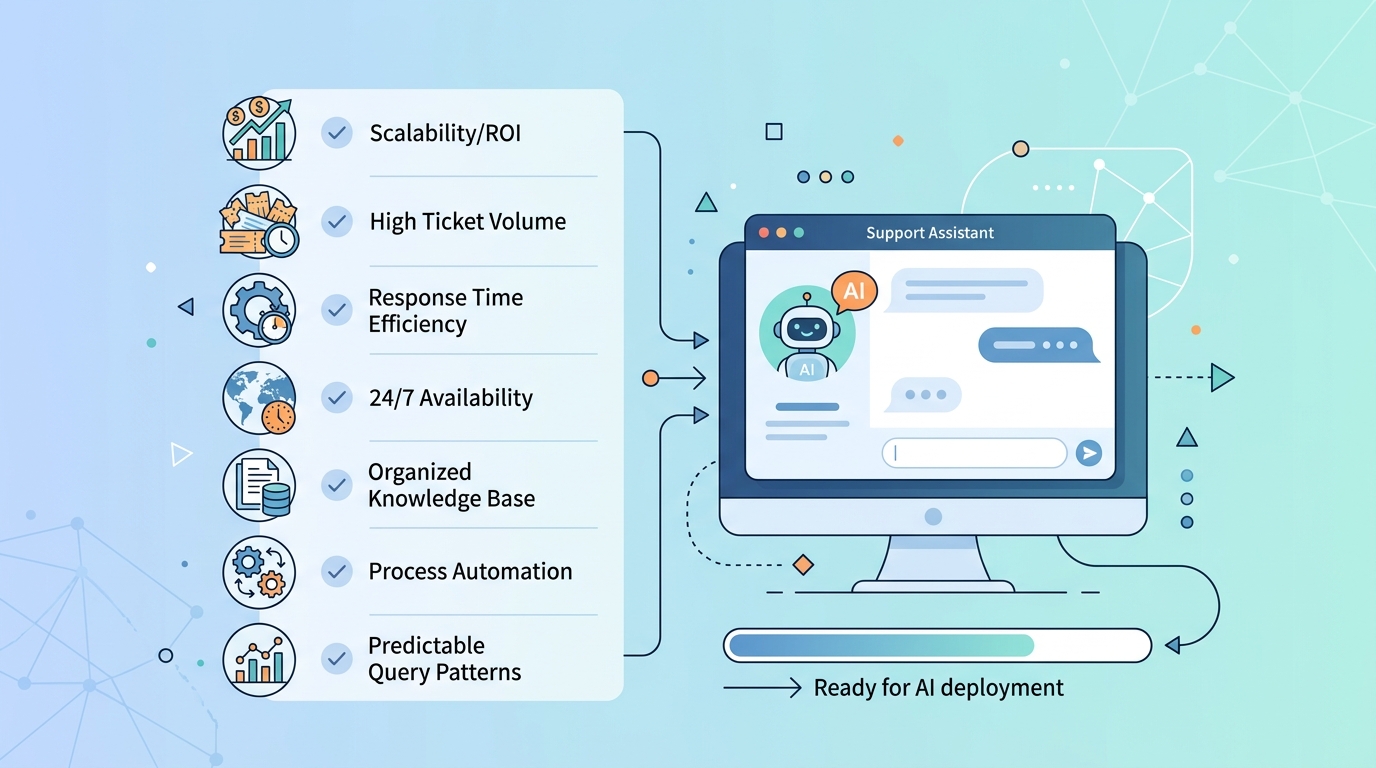
Not every business needs an AI customer support agent right now. Some organizations benefit enormously from deploying one immediately. Others would spend money on infrastructure that does not yet have enough volume to justify the investment.
The difference usually comes down to a few measurable signals - patterns in your support data, your operational costs, and your customer behavior that indicate whether an AI agent would create genuine leverage or just add complexity.
This article identifies the seven clearest signs that your business is ready. If several of these apply to you, the ROI calculation is likely already in your favor. If only one or two apply, you may be approaching the threshold but not yet there.
The Context: What AI Support Actually Does
Before evaluating readiness, it helps to be precise about what an AI customer support agent does - and what it does not do.
A well-deployed AI chatbot handles the predictable, high-volume, policy-bounded portion of your support queue automatically: frequently asked questions, order status, appointment booking, password resets, return processes, and similar tasks. It responds instantly, 24/7, in multiple languages, at a fraction of the cost of human agents.
What it does not do is replace the judgment, empathy, and contextual reasoning your best support agents bring to complex, emotionally charged, or edge-case interactions. The model that works is collaboration: AI handles the volume, humans handle the exceptions.
With that framing in place, here are the seven signs your business is ready.
Sign 1: Your Team Is Drowning in Repetitive Questions
The most direct indicator of AI readiness is the proportion of your incoming support volume that is genuinely repetitive.
If your team is answering the same 10-15 questions dozens of times per day - and those questions have clear, consistent answers - you have a strong AI use case. The bot will resolve those questions instantly and eliminate the labor cost of the human answering them.
What the data shows:
- 80% of customer service leaders agree that 20% or more of their tickets are repetitive and simple to resolve
- Tier-1 inquiries (password resets, order tracking, billing clarifications, opening hours) typically represent 50-80% of total ticket volume
- Companies report a reduction of up to 70% in call, chat, and email inquiries after implementing an AI assistant
- AI achieves ticket deflection rates of 40-70%+ in SaaS environments
The readiness threshold here is roughly: if your team fields the same question more than 10 times per day, or if repetitive queries represent more than 30% of total volume, automation is economically justified.
The caution: The AI needs answers to give. Before deploying, you must have a knowledge base that covers your most common questions accurately and completely. An AI that gives wrong answers is worse than no AI at all.
Sign 2: Your Response Times Are Failing Customer Expectations
There is a significant - and growing - gap between what customers expect in terms of response speed and what most businesses actually deliver.
If your average first response time is measured in hours rather than minutes, you are losing customers who have already found faster answers elsewhere. The expectation has moved. A response time that was acceptable three years ago is now a competitive disadvantage.
What the data shows:
- 90% of customers rate immediate response as critical to customer service
- 60% of customers define "immediate" as within 10 minutes or less
- 89% of customers expect email responses within 1 hour; 31.2% want a reply within 15 minutes
- The average actual email response time across industries: 12 hours 10 minutes
- AI reduces first response times from 6+ hours to under 4 minutes
- Best-in-class AI implementations achieve first contact times of under 10 seconds
The benchmark signal here is simple: if your average first response time exceeds 2 hours for chat or 4 hours for email, you are already behind customer expectations. The gap will widen as competitors move faster.
AI does not partially close that gap. It eliminates it. A chatbot responds the moment a message is sent, regardless of the time of day or the size of the queue.
Sign 3: You Have No Coverage Outside Business Hours
For any business that receives inquiries in the evenings, on weekends, or across time zones, a support team that operates on a 9-to-5 schedule is leaving quantifiable revenue on the table.
The customers who contact you after hours are often ready to buy or ready to commit - and when no one responds, they move to a competitor who answers immediately.
What the data shows:
- 30% of phone calls and over 50% of online inquiries arrive during evenings and weekends
- 64% of customers cite 24/7 availability as the top reason they prefer interacting with chatbots
- 74% of companies rate 24/7 availability as the single biggest benefit of deploying a chatbot
- 53% of online shoppers are likely to abandon a purchase if they receive no immediate assistance
- A service business with an average transaction value of $100-150 that misses just 5 after-hours calls and 3 weekend online inquiries per week loses 16 bookings per month - or $1,600-2,400 in direct monthly revenue
The AI agent does not need to solve complex problems during off-hours. It needs to capture leads, answer basic questions, book appointments, and ensure customers feel acknowledged rather than ignored. That alone recovers revenue that is currently being lost silently.
The readiness threshold: If more than 20-25% of your inquiries arrive outside staffed hours and you have no automated response, the lost-revenue calculation likely exceeds the cost of deployment within the first quarter.
Sign 4: Your Support Costs Are Growing Faster Than Revenue
When support headcount is the only lever available to handle volume growth, support becomes an increasingly expensive percentage of revenue. At some point, the unit economics break.
This is the structural signal that most CFOs and founders notice first: support costs are scaling linearly with customers, but margins are not improving.
What the data shows:
- A full-time U.S. customer service agent costs $40,000-55,000 in base salary; fully loaded with benefits, training, and tools: $60,000-80,000/year
- Labor represents 60-70% of total support costs
- Call center agent turnover runs at 30-40% annually - more than double the cross-industry average
- Replacing a single departing agent costs $10,000-21,000 (recruiting, onboarding, productivity ramp)
- A 100-agent team can incur $1.7 million/year in replacement costs alone
- Human agent cost per resolved ticket: $8-15 (fully loaded)
- AI cost per resolved interaction: $0.50-2.00
- That is a $9-14 cost difference per interaction - at high volume, a substantial savings
| Metric | Human Agent | AI Chatbot |
|---|---|---|
| Cost per resolved interaction | $8-15 | $0.50-2.00 |
| First response time | 6+ hours average | Under 4 minutes |
| Availability | Business hours | 24/7/365 |
| Languages supported | Depends on team | 80+ simultaneously |
| Scalability | Linear (hire more) | Instant (no limit) |
| Annual cost (100 agents) | $6-8 million | Fraction of that |
The readiness threshold: If you have more than 3-5 full-time support agents handling primarily repetitive tier-1 queries, and volume is growing, the economics of AI are almost certainly favorable. The average SMB deploying AI support reports a 340% first-year ROI (DemanSage). Larger businesses report $3.50 returned for every $1 invested (Freshworks).
Sign 5: Your Support Team Is Burning Out and Quality Is Declining
Repetitive, high-volume support work is not sustainable for human agents. When a significant portion of the team's day is spent answering the same questions over and over, morale degrades, errors increase, and attrition accelerates.
This is not a management problem. It is a structural problem. And it is solvable with AI.
What the data shows:
- Agents spend an average of 37% of their time on unproductive, repetitive tasks
- 95% of support agents say performance pressure decreases their productivity
- 75% of agents say daily ticket targets increase their stress
- At least 35% of customers become angry during support interactions - agents absorb this continuously
- Call center agent attrition is the #1 hindrance to achieving good First Contact Resolution rates
- AI reduces average handle time by 45% and resolves customer issues 44% faster
- Generative AI assistants boosted agent productivity by 14% on average (NBER research)
The goal of AI in this context is not to replace agents. It is to change the nature of their work. When the bot handles the flood of repetitive tier-1 queries, the agents who remain deal with more complex, more interesting, and more emotionally meaningful work. Job satisfaction typically improves.
The readiness signal: A growing ticket backlog, rising escalation rates, declining CSAT scores, frequent sick days, and visible attrition among support staff are measurable signs that the support function has hit its ceiling. These are not personnel problems - they are capacity problems that AI addresses structurally.
Sign 6: You Face Predictable Volume Spikes You Cannot Staff For
Some businesses have relatively stable support volume year-round. Others experience sharp, predictable spikes - during product launches, seasonal promotions, Black Friday, enrollment periods, or any high-traffic event.
Human staffing for spikes is expensive, slow to mobilize, and inevitably under- or over-provisioned. You hire too many people for the spike and have excess capacity the rest of the year, or you hire too few and quality collapses when it matters most.
AI scales instantly. The same bot that handles 50 conversations per day handles 5,000 without configuration changes, additional costs, or degraded response times.
What the data shows:
- E-commerce support ticket volumes spike 200-500% between November and January
- Black Friday alone has driven volume spikes of up to 800%
- During BFCM 2025, AI chatbot interactions rose 85% year-over-year
- AI chatbots resolved 65% of holiday inquiries without human transfer
- One retailer cut Black Friday response time from 12 hours to 90 seconds using AI, handling 80% of resolved tickets automatically
- E-commerce companies using AI-first platforms report staffing needs dropping 68% during busy periods
- AI can automate up to 70% of repetitive peak-season queries (order status, returns, shipping, hours)
The readiness signal: If your team struggles during a product launch or seasonal window - losing customers, burning out staff, or both - AI is the structural fix. Not temporary contractors. Not overtime. Not longer queues with apologetic auto-replies.
Sign 7: Your Customers Are Asking for Faster, Self-Service Options
Customer behavior has shifted. The expectation of being able to resolve a simple issue without waiting on hold or sending an email has moved from preference to standard expectation. Businesses that require customers to wait for basic answers are now at a competitive disadvantage.
This shift is measurable - and it is accelerating.
What the data shows:
- 61% of customers prefer self-service resources for simple issues instead of contacting a live agent
- 82% of consumers would rather use a chatbot than wait for a human agent for simple transactions
- 62% of customers prefer chatbots over waiting on hold
- 74% prefer chatbots specifically for simple questions
- 69% prefer self-service resolution when it is available
- In 2024, 61% of customers said they prefer contacting brands via digital channels, up from 45% in 2023 - a 36% jump in a single year
- 72% of people switch to a competitor after just one negative interaction
- Poor customer service puts $3.7 trillion in global revenue at risk globally (Qualtrics XM Institute)
- 87% of customers report positive experiences with AI chatbots
The preference for self-service is not a niche behavior. It is the majority preference for simple interactions. Businesses that force customers through a queue or a form for questions an AI could answer in 10 seconds are creating unnecessary friction.
The readiness signal: If your customers are regularly asking basic questions that have definitive answers, and if any meaningful portion of them are abandoning before resolution, self-service AI closes that gap directly.
What Readiness Is Not
Not every business has reached the threshold. These are the conditions that indicate you may be premature:
Volume too low: An AI agent is most valuable when there is enough repetitive volume to justify the deployment and optimization investment. If you receive fewer than 50-100 support tickets per month, the economics do not yet work cleanly. Build the knowledge base and wait for the volume to grow.
No knowledge base: AI can only answer questions it has been trained to answer. If your business has not documented its policies, FAQs, and procedures, the AI will fail. The prerequisite is content, not technology.
No escalation path: AI without a clear path to a human agent is a dead end for customers with complex problems. Every deployment needs an explicit handoff mechanism.
The research here is instructive: 40% of early chatbot deployments were abandoned within two years, and over 65% of chatbot failures trace back to poor escalation design rather than the AI itself.
The Minimum Viable AI Deployment
If the signs above apply to your business, here is the minimum configuration required before going live:
- A knowledge base covering at least your top 20-30 most common questions, with accurate and current answers
- A defined escalation path - a visible, easy way for customers to reach a human when the bot cannot help
- Ticket volume of at least 100/month to generate meaningful performance data
- A 30-60 day monitoring window to catch gaps in coverage and calibrate the knowledge base
- Ownership of the bot - someone responsible for reviewing escalations, updating answers, and improving coverage over time
An AI agent is not a one-time installation. It is a support channel that improves with attention. The businesses that see the highest returns are those that treat the bot as a living system rather than a configured tool.
The ROI Case
The financial case for AI support, when the conditions are right, is among the strongest in the software category:
- Average return: $3.50 for every $1 invested (Freshworks)
- SMB first-year ROI: 340% on average (DemanSage)
- Typical payback period: 60-90 days to initial positive ROI; 8-14 months to full payback
- Cost reduction: 25-30% median reduction in total support costs
- Top-line impact: AI chatbots contribute to 23% higher conversion rates for websites that deploy them
The combination of cost reduction and revenue recovery (from faster responses, after-hours availability, and lead qualification) makes AI support one of the few business investments that improves both sides of the income statement simultaneously.
Next Steps
If three or more of the seven signs above describe your business, you have crossed the readiness threshold.
The practical next step is not a multi-month integration project. It is a focused deployment: train a bot on your most common questions, add it to your highest-traffic page, and measure deflection and CSAT for 30 days. The data from those first 30 days will tell you exactly where to expand and where to adjust.
Paperchat is built for exactly this kind of deployment - a trained AI chatbot on your website in under 30 minutes, with a human handover built in and a knowledge base you control.
More Articles
How to Automate Customer Support Without Losing the Human Touch
The practical guide to using AI chatbots for customer support in a way that feels helpful, not cold — including when to hand off to a human.
March 29, 2026
10 Customer Support Tasks You Can Automate with an AI Chatbot Today
A detailed breakdown of the customer support tasks AI chatbots handle best — with data, real examples, and guidance on where human agents still matter.
April 8, 2026