
How Agencies Are Reselling AI Chatbot Software to Clients
Digital agencies are turning AI chatbot software into a high-margin recurring revenue stream. Here is how the agency reseller model works, what it pays, and what platforms make it viable.


Digital agencies have historically sold time. A web design project closes, delivers, and ends. An SEO retainer runs month to month but is vulnerable to budget cuts when clients want to see faster proof of ROI. Social media management is perpetually undervalued and subject to in-house replacement. The structural problem for most agencies is that their revenue is either project-based and lumpy, or retainer-based but fragile.
AI chatbot services are emerging as a different kind of product - one that is genuinely sticky, difficult to replicate without specialist knowledge, and delivers measurable ROI that clients can see in the first 30 days. For agencies that understand the model, it represents a reliable path to recurring revenue at margins far above what traditional agency services achieve.
This analysis covers how the agency reseller model for AI chatbot software works in practice, what agencies are charging, what the platform economics look like, and what the implementation workflow that drives successful deployments looks like.
The Market Opportunity
The AI chatbot market is not a speculative bet. The sector is growing at a 23.5% compound annual growth rate and is projected to reach $27.3 billion by 2030 (Grand View Research, 2025). Businesses of every size are under pressure to reduce operational costs while improving customer response times - and AI chatbots are the clearest current path to achieving both simultaneously.
The agency opportunity exists because most small and mid-sized businesses cannot evaluate, deploy, and maintain an AI chatbot system on their own. They need a trusted partner who already understands their website, their customers, and their operations - which is exactly what a digital agency already is.
The agencies capturing this opportunity are not AI specialists. They are marketing agencies, web design firms, SEO consultants, and paid media shops that have recognized a simple dynamic: their existing clients trust them with their digital presence, and AI chatbot deployment is a natural extension of that relationship.
How the Agency Reseller Model Works
The reseller model is straightforward: the agency licenses a white-label or multi-tenant chatbot platform at a wholesale rate, deploys and manages chatbots for clients under its own brand, and charges clients a monthly management fee that includes setup, training, optimization, and support.
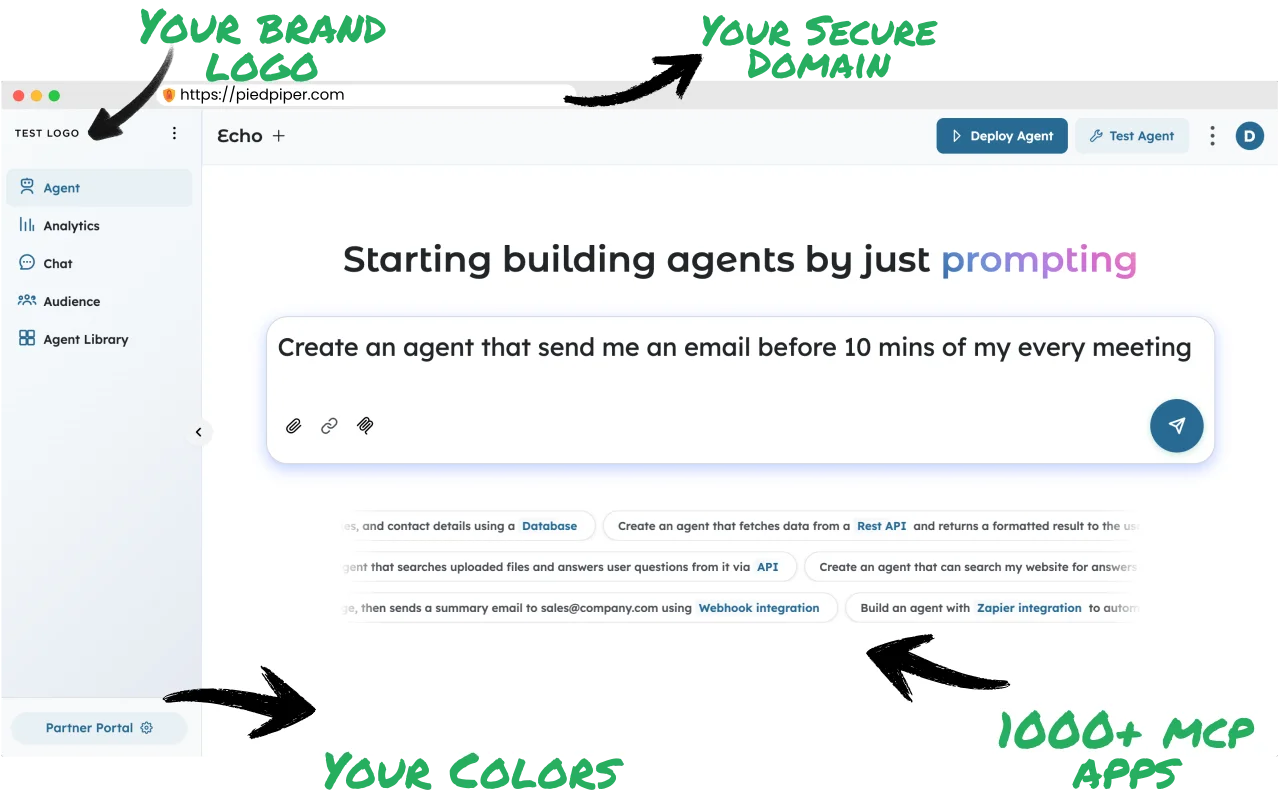
The underlying platform - Paperchat or equivalent - never appears to the client. The client sees the agency's branded service. The agency controls the positioning, the pricing, the relationship, and the margin.
Three Common Agency Pricing Structures
| Model | Structure | Typical Price Range | Best For |
|---|---|---|---|
| Flat monthly retainer | Fixed fee per client per month | $200-500/client/month | Agencies wanting predictable ARR |
| Usage-based markup | Platform cost + percentage markup | 200-400% over platform cost | Agencies with clients of varying scale |
| Setup + retainer | One-time onboarding fee + recurring management | $500-1,500 setup + $150-300/month | New clients with significant training needs |
| White-glove enterprise | Full-service with custom training, analytics, reporting | $800-2,500/month | B2B agencies serving mid-market clients |
The flat monthly retainer is the most common starting point for agencies entering this space. At $300/month per client, a 20-client book of business generates $6,000 MRR - before accounting for upsells, reporting add-ons, or additional chatbot deployments for larger clients.
What Agencies Include in Chatbot Service Packages
The monthly retainer justification is critical. Clients are not paying for the software - they are paying for expertise, management, and outcomes. A typical chatbot service package includes:
- Initial strategy and scoping: Identifying the client's highest-volume inquiry types and designing the chatbot scope around them
- Content collection and knowledge base setup: Gathering the policies, FAQs, product/service information, and procedures that train the chatbot
- Technical deployment: Installing the widget on the client's website, configuring design to match brand guidelines, testing across devices
- Workflow configuration: Setting up lead capture, human handover rules, notification routing, and integrations with the client's CRM or calendar tools
- Ongoing optimization: Monthly review of conversation logs, identification of unanswered or poorly-answered questions, knowledge base updates
- Analytics reporting: Monthly reporting on conversation volume, deflection rate, lead captures, and chatbot ROI relative to baseline
- Priority support: Direct agency support for any issues that affect the client's chatbot availability
At this scope, the monthly fee is not a software markup - it is a managed service. Clients who understand what they are buying do not cancel it.
What Agencies Need from a Chatbot Platform
Not all chatbot platforms are suited to the agency model. Platforms built for single-company deployments typically lack the multi-tenancy, white-labeling, and client management features that agencies require. The platform evaluation criteria that matter for resellers:
1. Multi-Tenant Management
The agency needs a single dashboard to create, configure, monitor, and manage chatbots across all client accounts. Logging into 20 separate client accounts to perform routine maintenance is operationally unsustainable. A platform that treats each client as a separate tenant - isolated data, individual configuration, separate usage tracking - while giving the agency a unified management view is essential.
2. White-Label Capability
The agency's brand should be what the client sees. This applies to the chat widget, any client-facing portals, email communications from the system, and any reporting. The underlying platform name should not appear in client-facing contexts. Agencies that let the platform brand show through are effectively building awareness for the platform vendor, not themselves.
3. Fast Onboarding
The economics of the reseller model depend on low time cost per client deployment. If setting up a new client chatbot takes 40 hours, the agency is selling its time at a poor rate regardless of the monthly retainer. Platforms with structured onboarding workflows, website crawling for automatic content ingestion, and template-based configuration can reduce deployment time to 4-8 hours per client - a fundamentally different unit economics calculation.
4. Integrations with Client Tools
The clients agencies serve use a heterogeneous stack: WooCommerce, Shopify, Squarespace, WordPress, HubSpot, Salesforce, Calendly, Cal.com, Zapier. A platform that integrates with this ecosystem allows the agency to offer meaningfully higher-value deployments - chatbots that sync with client CRM, book appointments on client calendars, look up order status in real time - rather than standalone FAQ widgets.
5. Predictable, Scalable Pricing
The platform's pricing model must create room for a meaningful agency margin. A platform that charges $49/month for a Pro plan that covers multiple chatbots gives the agency real margin flexibility. A platform that charges $99/chatbot makes the economics difficult at entry-level client budgets.
Revenue Model Analysis: Building to $10K MRR
The following model illustrates how a mid-sized digital agency builds AI chatbot revenue to $10,000 monthly recurring revenue:
Starting scenario: An agency with 8 existing web design and SEO clients begins offering AI chatbot management as an add-on service.
Month 1-3: Convert 5 existing clients at $250/month. MRR: $1,250. Platform cost for 5 chatbots on a Pro plan: approximately $49-99/month. Net margin: approximately 90%.
Month 4-6: Add 8 new chatbot clients - mix of existing clients and new chatbot-only engagements at $300/month average. MRR: $3,650. Platform cost scales modestly with volume. Net margin remains above 80%.
Month 7-12: Agency reputation for AI chatbot work generates referrals. Total client count reaches 22 at a blended average of $320/month. MRR: $7,040. Begin offering a premium analytics and optimization tier at $500/month for 6 clients. Total MRR: $7,040 + $3,000 = $10,040.
Platform cost for 28 clients on an enterprise-tier platform: approximately $300-600/month depending on usage. Net margin on the AI chatbot service line: 85-92%.
The critical insight is that unlike web design or social media management, AI chatbot management does not scale linearly with time. After the initial setup, ongoing management requires reviewing conversation logs, updating the knowledge base monthly, and generating reports - typically 1-3 hours per client per month. An agency carrying 25 chatbot clients is spending 25-75 hours monthly on the entire service line while generating over $10,000 in recurring revenue.
The Sales Pitch: ROI Framing for Existing Clients
The agency's existing client relationships are the primary distribution channel. Converting an existing client to a chatbot service requires a different conversation than selling a new web design project - it is a business case pitch, not a deliverables pitch.
The framing that converts most consistently:
For service businesses (medical practices, law firms, agencies, consultants): "You're currently losing inbound inquiries after hours and on weekends because no one is there to respond. We can deploy an AI chatbot that responds instantly 24/7, captures lead information, and books appointments on your calendar. For $300/month you recover 2-3 missed leads a month - at your average client value, that's 10x ROI."
For e-commerce clients (WooCommerce, Shopify): "About 40% of your support email volume is order status questions. An AI chatbot answers those automatically, 24/7, without any staff time. At $10/email handled manually, that's $400-800 in saved time every month before the first month is out."
For SaaS and digital product clients: "Your trial conversion rate is being depressed by the gap between when users have a question and when your team responds. An AI chatbot that answers product and pricing questions instantly during the trial period directly increases conversion - this is measurable in your trial metrics within 30 days."
The pattern in each frame is the same: identify a specific, quantifiable cost or lost revenue the client already experiences, then show the chatbot as the direct solution with a payback calculation that the client can verify.
Onboarding Workflow: From Close to Live in Under One Week
The agency's competitive advantage is the ability to get a client chatbot live quickly. A structured onboarding workflow that consistently delivers in under a week:
Day 1: Discovery and Content Collection
- Identify the 15-20 questions the client's customers ask most frequently
- Collect existing documentation: FAQ pages, return policies, service descriptions, pricing, hours, contact information
- Identify integrations required: CRM, calendar, e-commerce platform, CMS
Day 2-3: Knowledge Base Build and Configuration
- Set up the client account in the platform
- Import collected content into the knowledge base
- Configure the chatbot scope, persona, and escalation rules
- Set up required integrations
- Configure lead capture and notification routing
Day 4: Design and Deployment
- Customize the chat widget to match the client's brand (colors, logo, greeting message)
- Install on client website
- Test across desktop and mobile, including escalation paths and lead capture flows
Day 5: Review and Handoff
- Conduct a live walkthrough with the client
- Walk through conversation logs from internal testing
- Document what the chatbot handles and what it escalates
- Establish monthly review cadence
Day 6-7: Buffer for revisions
At this workflow pace, an agency can comfortably onboard 2-3 new chatbot clients per week without disrupting other service delivery.
Paperchat and the Agency Model
Platforms built for multi-tenant deployment change what the agency reseller model is capable of achieving. Paperchat's architecture supports the agency use case at its core: multiple client accounts under a single agency management view, credit-based billing that scales with client usage rather than charging per chatbot, team management features that let agency staff and client stakeholders have appropriate access levels, and integration breadth that covers the tools most agency clients already use.
For agencies evaluating platforms, the operational question is: how much of the ongoing management work does the platform absorb, and how much does it create? A platform with strong content ingestion, easy knowledge base updates, and clear conversation analytics reduces the monthly time cost per client substantially - which is what enables the margin profile outlined above.
The white-label capability is equally important: agencies selling a managed service under their own brand cannot afford to have their clients discover and evaluate the underlying platform independently. The value proposition depends on the agency owning the relationship.
Common Pitfalls in the Agency Reseller Model
The agencies that struggle with the AI chatbot reseller model typically encounter one of three problems:
Under-pricing for sustainability. Agencies entering the market at $99-150/month to win clients often find the time cost of client management exceeds what the price allows. The minimum viable price for a managed service - not a software resale - is $200/month for entry-level clients, and this requires platform economics that support it.
Over-promising on automation. An AI chatbot is not a call center replacement. Agencies that promise clients their phone volume will drop 80% set up for disappointment. The honest case is more sustainable: expect 40-60% deflection of repetitive inquiries within 30 days, with improvement over time as the knowledge base develops.
Neglecting knowledge base maintenance. A chatbot that performs well at launch and degrades over time because its knowledge base is never updated is a churn driver. Monthly knowledge base reviews - even 30 minutes per client to check unanswered questions and update outdated content - are the difference between clients who renew indefinitely and clients who question the value in month 6.
The Structural Advantage of AI Chatbot Services
The highest-performing agencies in the chatbot reseller space have recognized something that distinguishes this service from most other agency offerings: the chatbot generates evidence of its own value every month. Conversation logs show volume handled. Lead capture reports show contacts generated. Deflection rates show support tickets not created. The monthly report is not a vanity metrics exercise - it is a documented, measurable ROI calculation.
In an industry where proving the value of marketing spend is a constant challenge, a service that self-reports its impact is structurally different. The renewal conversation is not "trust us, this is working" - it is "here are the 847 conversations your chatbot handled last month, the 23 leads it captured, and the 14 hours of support time it saved."
That is the kind of evidence that retains clients - and that builds the recurring revenue base that most agencies spend years trying to create.
More Articles
How to Add a Live Chat Widget to Your Website in Under 10 Minutes
A step-by-step guide to installing Paperchat's AI chat widget on any website — no developer required.
March 29, 2026
How to Train an AI Chatbot on Your Own Business Data
Learn how to feed your website, documents, and FAQs into Paperchat so your AI chatbot answers like an expert on your business.
March 29, 2026
How to Capture More Leads with an AI Chat Widget on Your Website
Turn passive website visitors into qualified leads using Paperchat's AI chat widget — with proactive messaging, lead forms, and CRM sync.
March 29, 2026