


Every business owner has encountered the question by now. A competitor has a chat widget on their website that answers questions at midnight. A vendor is pitching an AI solution. An employee suggests it would save the support team ten hours per week. The term "AI chatbot" appears everywhere - but the actual explanation of what one is, how it works, and whether it is right for a specific business rarely follows.
This guide strips away the jargon and answers those questions plainly. No computer science degree required.
What Is an AI Chatbot, Actually?
An AI chatbot is software that holds text conversations with people visiting your website or app and responds intelligently based on what it has been trained to know.
That definition contains three important words: "intelligently," "trained," and "conversations."
Unlike a phone menu that forces you to press 1 for billing and 2 for technical support, an AI chatbot understands what a person means, not just what they typed. A visitor can type "I need to send something back" and the chatbot understands they mean a return, even if the word "return" never appeared. It can ask a follow-up question, provide policy details, and walk the visitor through the process - all within the same conversation window.
Unlike a static FAQ page, the chatbot is interactive. It meets the visitor where they are in their question, narrows down exactly what they need, and delivers a targeted answer rather than a wall of text they have to search through themselves.
And unlike a live chat widget staffed by humans, the AI chatbot is available at 3am on a Sunday and can handle 500 simultaneous conversations without any additional cost.
How AI Chatbots Actually Work (No Jargon)
Understanding the mechanics behind an AI chatbot does not require a technical background. There are four components that matter for a business owner:
Natural Language Processing: Understanding Meaning, Not Just Keywords
Older chatbots were essentially keyword matchers. A customer typed "refund" and the bot showed a refund page. Type "money back" and the bot returned nothing useful.
Modern AI chatbots use Natural Language Processing (NLP) - a branch of AI that teaches machines to understand human language the way humans use it, with all its synonyms, abbreviations, context, and imprecision. When a customer types "my order hasn't shown up and it's been two weeks," an NLP-powered chatbot understands this as a shipping concern involving a specific timeframe, not a string of disconnected keywords.
This is the foundation that makes AI chatbots feel like conversations rather than search engines.
The Knowledge Base: What the Chatbot Knows Comes from You
An AI chatbot is only as good as what it has been taught. The "knowledge base" is the body of information the chatbot draws from when answering questions: your website content, your product documentation, your FAQ articles, your pricing pages, your return policies - any text content about your business.
When you set up a chatbot platform like Paperchat, you train it on your own content. You can upload documents, paste in URLs, add product information, or write out common questions and answers directly. The chatbot learns your specific business, not just general knowledge about the world.
This is a critical point that gets lost in the marketing. A chatbot that has not been trained on your content will give generic or wrong answers. A chatbot trained thoroughly on your content will answer like a knowledgeable member of your team.
Large Language Models: The Engine That Generates Responses
The conversational quality of modern AI chatbots comes from Large Language Models (LLMs) - the same technology behind tools like ChatGPT. Models like GPT-4 are trained on enormous amounts of text and develop a deep understanding of language patterns, context, and how to formulate coherent, helpful responses.
The LLM is the engine. When a visitor asks a question, the LLM generates a natural-sounding response in plain English (or any other language), not a robotic script pulled from a database.
For a business owner, this means the chatbot sounds human and adapts its language to the context of each conversation - something rule-based bots of a decade ago could never achieve.
RAG: Why Your Chatbot Gives Accurate Business Answers
There is one more component that separates a generic AI from a business-grade chatbot: Retrieval-Augmented Generation, or RAG.
Here is the problem RAG solves. LLMs know a lot about the world in general, but they do not know your specific return policy, your current product pricing, or your unique service terms. If you ask a raw LLM about your business, it will either admit it does not know or - worse - generate a plausible-sounding answer that is factually wrong.
RAG fixes this by giving the AI a structured way to look up your specific content before answering. When a visitor asks a question, the chatbot first searches through your knowledge base to find the most relevant pieces of your actual business content, then uses the LLM to compose a response using that information as its source of truth.
The result: your chatbot gives accurate, specific answers about your business rather than hallucinating details or defaulting to generic responses. This is what makes a chatbot trustworthy enough to put in front of customers.
Types of AI Chatbots
Not all chatbots are built for the same purpose. The five most common types a business might consider:
Customer Support Chatbots handle inbound questions from existing customers - order status, account issues, troubleshooting, returns. These are the most common deployment and often deliver the fastest ROI because they directly reduce support team workload.
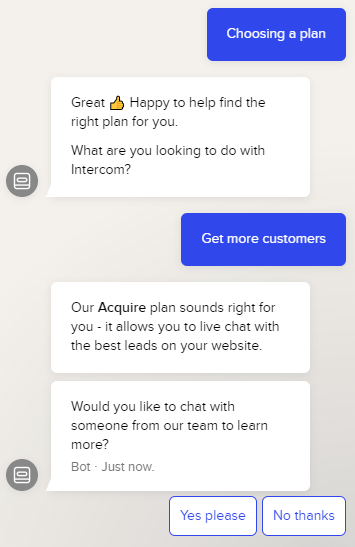
Lead Generation Chatbots engage website visitors proactively, qualify them by asking discovery questions, and capture contact information for the sales team. Instead of a passive contact form that most visitors ignore, a lead gen chatbot starts a conversation and moves qualified prospects toward a meeting or demo.
Booking and Appointment Chatbots integrate with scheduling tools to let visitors book meetings, appointments, or calls directly through the chat window. Service businesses, consultants, and healthcare providers find particular value here.
E-commerce Chatbots help shoppers find products, check order status, process returns, and get sizing or compatibility guidance. Advanced implementations connect directly to product catalog and order management systems, enabling the chatbot to give real-time answers about availability and shipping.
Hybrid AI and Human Chatbots combine all of the above with the ability to seamlessly hand conversations to a live human agent when needed. This is now considered the best-practice model - AI handles the volume, humans handle the complexity.
What AI Chatbots CAN Do
The capabilities list has expanded significantly in recent years:
- Answer questions accurately and instantly, drawing from your trained knowledge base, at any hour and to any number of simultaneous visitors
- Work 24 hours a day, 7 days a week, without shifts, sick days, or overtime costs
- Handle thousands of simultaneous conversations with no degradation in response quality - scaling in a way no human team can replicate
- Capture leads by collecting visitor name, email, and intent before or during a support conversation
- Escalate to human agents when a conversation exceeds AI capability, passing the full conversation history so the human does not start from scratch
- Communicate in multiple languages, often without explicit configuration
- Learn from your content updates, so when you update your pricing page or add a new product, you can retrain the chatbot to reflect the change
- Integrate with other business systems like CRMs, helpdesk platforms, and e-commerce backends
What AI Chatbots CANNOT Do
Honesty matters here, because inflated expectations lead to poor implementations and disappointed business owners.
AI chatbots cannot reliably handle situations that require genuine human judgment - nuanced complaints, negotiation over refunds above certain thresholds, legal disputes, or situations where company policy leaves room for discretion. These require a human who has authority and can read the full context of a customer relationship.
They cannot handle completely novel situations with no precedent in their training data. If a customer presents an edge case your content has never addressed, the chatbot may give an unhelpful or incorrect response.
They do not guarantee 100% accuracy. Even well-trained chatbots occasionally misunderstand intent or retrieve the wrong content. Quality platforms include confidence scoring so the chatbot recognizes when it is uncertain and escalates rather than guessing.
They cannot fully detect emotion or tone. A chatbot can be configured to watch for keywords suggesting frustration, but it does not experience the conversation the way a human does. A distressed or grieving customer may need a human response for reasons the AI will not fully grasp.
Used within these limits - which represents the majority of real-world support volume - AI chatbots perform extremely well. The key is designing for the boundary: clear escalation paths to humans when the AI reaches its edge.
Business Benefits with Real Numbers
The business case for AI chatbots has moved from theoretical to empirically supported. The data from deployments at scale:
- Response time: AI chatbots respond in under 3 seconds. Human-staffed chat averages 6.8 hours. Email support averages 12.1 hours (SuperOffice, 2024).
- Cost per interaction: AI handles a customer interaction for $0.25-2.00. A human agent interaction costs $8-15 in the US and UK (Freshworks, 2025). That is a 12x cost differential.
- Availability: Staffing a human support desk for 24/7 coverage at a small business requires at minimum 3-4 full-time equivalent roles. A chatbot has no off hours.
- Scale: One AI deployment handles thousands of simultaneous conversations. A human agent handles one. During traffic spikes - product launches, seasonal sales, outages - the chatbot does not break under load.
- Adoption: 80% of businesses are expected to use chatbots by 2026 (Outgrow). This is not a leading-edge technology; it is rapidly becoming table stakes.
- Customer preference: 69% of consumers prefer chatbots for quick answers (Salesforce). The assumption that customers universally dislike bots no longer holds.
- Resolution: Well-trained AI chatbots resolve 60-80% of routine support queries without human involvement (Freshworks, 2025).
Cost Per Customer Interaction
Human agent vs. AI chatbot (USD)
Source: Freshworks / Juniper Research, 2025
Business AI Chatbot Adoption
Percentage of businesses deploying chatbots
Source: Outgrow / Tidio Research, 2025
These numbers compound. A business handling 500 support interactions per month that shifts 70% to AI resolution saves approximately $3,000-$4,500 per month in direct handling costs, before accounting for after-hours coverage or the productivity gains for the support team.
Common Myths and What the Data Actually Shows
Several persistent myths shape how business owners evaluate AI chatbots. Each deserves direct examination.
Myth: Customers hate chatbots.
Reality: 69% of consumers prefer chatbots when they want a quick answer (Salesforce). The frustration customers actually report is with bad chatbots - ones that misunderstand, loop, and never connect to a human. The experience of a well-trained chatbot with clear escalation is rated positively by most users. Chatbot interactions now receive an average satisfaction score of 87.58% - higher than the 85.8% average for human agents (Alhena.ai, 2025).
Myth: AI chatbots are only for large enterprises.
Reality: Small and mid-size businesses frequently see the highest return on investment proportionally. An enterprise with 50 support agents deflecting 30% of volume with AI saves considerable money, but the percentage impact on capacity is smaller. A 3-person support team deflecting 60% of routine volume with AI effectively doubles their capacity to handle complex work without hiring.
Myth: Chatbots replace customer service staff.
Reality: The best implementations use AI to handle the routine and repetitive - the questions that have known, consistent answers. Human agents focus on complex issues, sensitive situations, and high-value interactions. The outcome is not fewer jobs but different work: less time answering "what is your return policy" and more time solving the 5% of issues that actually require human expertise and authority.
Myth: AI chatbots are expensive and complicated to set up.
Reality: Modern SaaS platforms have made setup genuinely accessible. Paperchat, for example, allows a business owner to connect a chatbot to their website, upload their documentation, and go live - without writing a single line of code and often within the same working day. The cost structure is subscription-based, typically starting under $50 per month at introductory tiers. The payback period from support cost reduction alone is often measured in weeks, not years.
How to Evaluate and Deploy Your First AI Chatbot
For a business owner who has determined that an AI chatbot is worth exploring, a simple four-step framework:
Step 1: Identify the use case. Start specific rather than broad. What single category of customer interactions consumes the most support time? Returns and refunds? Order status? Pricing questions? Scheduling calls? Pick the one highest-volume, most repetitive category and build the case for solving that first. Trying to solve everything at once is how implementations fail.
Step 2: Audit your existing content. The chatbot's quality is bounded by its training material. Before selecting a platform, collect the content that would answer the questions you want the chatbot to handle: help center articles, product pages, policy documents, FAQ pages. Gaps in your content are gaps in your chatbot. This audit also frequently reveals documentation debt - outdated policies, missing information - that is worth fixing regardless of the chatbot project.
Step 3: Choose a platform that matches your technical reality. Evaluate platforms on three axes: the quality of responses from your specific content (run real test questions during a trial), the ease of setup and retraining without developer involvement, and the integration capabilities for your existing stack (CRM, helpdesk, e-commerce platform). Look specifically for platforms that include human handover capability - a chatbot with no escalation path is a liability, not an asset.
Step 4: Measure from day one. Define success before you launch. At minimum track: deflection rate (the percentage of conversations the AI resolves without human escalation), customer satisfaction score on chatbot interactions, and the response to "did this answer your question?" within the chat window. Set a 90-day baseline and review against it. The metrics tell you where to improve training content and where to refine the escalation thresholds.
The technology has matured to a point where the risk of a thoughtful implementation is low. The larger risk, as adoption accelerates, is in waiting.
What to Look for When Comparing Platforms
The market for AI chatbot platforms has expanded rapidly. Evaluating them against each other requires a clear set of criteria beyond the marketing claims.
Knowledge base quality and retrieval accuracy is the most important technical differentiator. Ask every vendor: how does the chatbot handle a question where the answer is partially in one document and partially in another? What happens when the knowledge base contains contradictory information? Can you see which source the chatbot drew from when answering? Platforms that cannot answer these questions have RAG implementations that will produce inconsistent results at scale.
No-code training and retraining matters because your business content changes. Pricing changes. Products launch and retire. Policies update. A chatbot platform that requires developer involvement every time the knowledge base needs updating will quickly fall out of date. Look for platforms where any team member can add, remove, or update training content through a standard interface.
Human handover capability is non-negotiable for customer-facing deployments. Any platform without a configurable escalation path to a human agent is not suitable for production customer support. Evaluate the handover specifically: does the agent receive the full conversation history? Is there a notification system? Can you configure the escalation triggers?
Analytics and visibility are what allow you to improve over time. Deflection rate, CSAT scores, conversation volume by topic, and escalation rate are the minimum. Platforms that do not surface these metrics leave you operating blind.
Integration support determines whether the chatbot can become part of your existing workflow or remains an isolated tool. CRM sync, helpdesk integration (Zendesk, Freshdesk, Intercom), and e-commerce platform connectivity (Shopify, WooCommerce) separate platforms that can replace workflow from platforms that add to it.
Customers asking questions at midnight are not going to wait until morning. Leads that arrive on a Friday afternoon will talk to whoever answers first. Response speed has become a competitive variable in a way it simply was not five years ago - and AI chatbots are the most cost-effective tool available for addressing it.
More Articles
How to Add a Live Chat Widget to Your Website in Under 10 Minutes
A step-by-step guide to installing Paperchat's AI chat widget on any website — no developer required.
March 29, 2026
How to Train an AI Chatbot on Your Own Business Data
Learn how to feed your website, documents, and FAQs into Paperchat so your AI chatbot answers like an expert on your business.
March 29, 2026
8 Ways AI Chatbots Reduce Support Ticket Volume
A detailed breakdown of how AI chatbots cut inbound support ticket volume, with current performance benchmarks, real case studies, and practical guidance on implementation.
April 8, 2026