

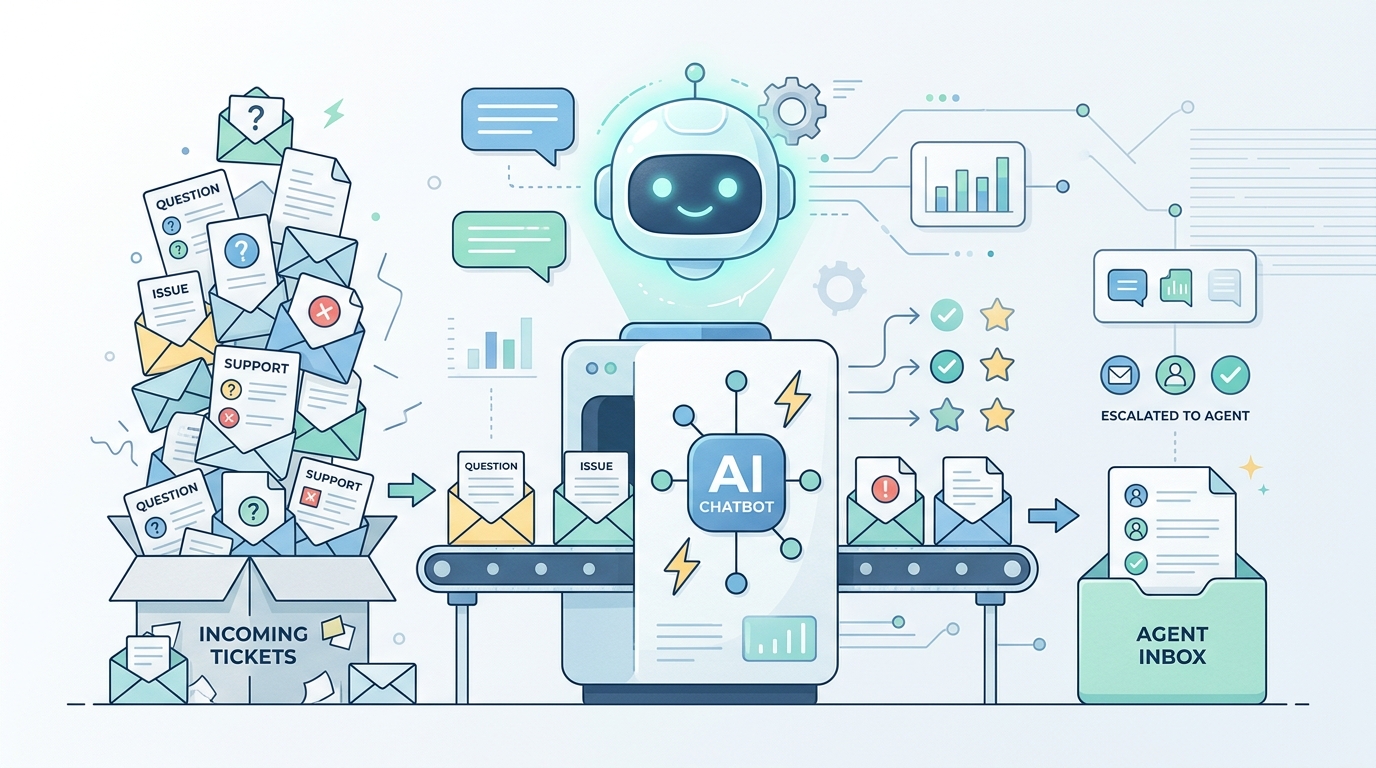
Most support teams are not drowning because their customers have more complex problems than they used to. They are drowning because the same routine questions - shipping status, return policy, password reset, account access - arrive in an unbroken stream every day, and each one requires a human to open a ticket, read it, type a reply, and close it.
AI chatbots do not eliminate the need for support. They eliminate the tickets that should never have required a human to begin with.
This article covers the eight specific mechanisms through which AI chatbots reduce inbound ticket volume, with current data, real-world case studies, and honest assessments of where each approach works - and where it falls short.
The Scale of the Problem
Before examining the mechanisms, it is worth establishing the baseline numbers that define the opportunity:
- AI chatbots currently deflect over 45% of incoming customer queries across retail and travel sectors; top implementations reach 80-90% (Freshworks, 2025)
- Gartner projects agentic AI will autonomously resolve 80% of common customer service issues without human intervention by 2029, reducing operational costs by 30%
- The average cost of a human-handled support interaction runs $8-15 in the US and UK; AI handles the equivalent for $0.25-2.00 - a 12x cost differential
- Conversational AI is projected to save $80 billion in contact-center labor costs by 2026 (Juniper Research)
- Companies using AI-powered support see average ROI of 2-5x within the first year (Pylon, 2025)
Ticket volume reduction is not a marginal gain. At best-in-class implementations, it is a structural shift in how support demand is absorbed.
1. Self-Service Deflection Through FAQ Automation
The majority of support tickets are questions with known answers. Return windows. Pricing. Shipping timelines. Upgrade paths. Cancellation procedures. The same 15-20 questions account for 40-60% of total ticket volume at most businesses, and the answer does not change from customer to customer.
AI chatbots with a well-maintained knowledge base resolve these questions instantly, at any hour, without creating a ticket.
What the data shows:
- Industry deflection rate benchmarks: 40%+ = good; 80%+ = great (Alhena.ai)
- IT and software teams using Freddy AI (Freshworks) deflect 45% of all incoming queries
- 47% of enterprise companies are automating self-service answers with AI
- Issues resolved by chatbot take 42 seconds on average - compared to hours for a queued ticket
- Chatbot interactions receive 87.58% satisfaction scores vs. 85.8% for human-agent interactions
The limiting factor here is not AI capability - it is knowledge base quality. A chatbot trained on outdated or incomplete information gives wrong answers, which erodes trust faster than a slow human response would. The operational discipline required is not AI configuration; it is keeping documentation current.
2. Proactive Chat That Stops Tickets Before They Start
The best support interaction is one the customer never had to initiate. AI can monitor behavioral signals - time on a page, repeated cart visits, patterns in navigation - and surface a message before frustration escalates to a ticket.
A customer who has been on the returns page for 45 seconds is probably trying to figure out the returns process. An AI chatbot that proactively asks "Can I help you with a return?" deflects a ticket that has not yet been submitted.
What the data shows:
- Juniper Research (2024): proactive AI interventions reduce ticket volume by 20-25% in mature SaaS implementations
- Cart abandonment fell 20-30% in retail implementations using proactive AI chat
- One e-commerce brand flagged recurring queries about shipping delays using AI, updated its tracking notifications, and reduced inbound tickets by 37% within two weeks
- Wyze Labs achieved an 88% self-resolution rate using proactive AI interventions
- Customers receiving high-intent proactive messages are 5x more likely to convert (Sobot, 2025)
Proactive chat requires behavioral data integration to work well. A bot that appears on every page after 10 seconds trains customers to dismiss it. The trigger logic matters as much as the chat content.
3. 24/7 Availability That Eliminates Backlog Accumulation
Support teams that operate business hours create predictable backlogs. Tickets submitted at 11pm on Friday sit until Monday morning. Customers who could have resolved their issue in minutes instead wait 60+ hours, often submitting multiple follow-ups in the interim - multiplying ticket volume from a single customer need.
AI chatbots do not accumulate backlog. They handle queries the moment they arrive.
What the data shows:
- 64% of consumers cite 24/7 availability as the most helpful chatbot feature (Chatbot.com, 2026)
- Average AI chatbot response time: under 3 seconds vs. human agent first response averaging 6.8 hours
- Chatbots lower support backlogs by 48% (Thunderbit, 2026)
- SaaS companies operating AI chatbots reduce after-hours staffing costs by 70-80%
- Human agents see a 21% productivity increase when AI handles after-hours triage
- First response time dropped from over 6 hours to under 4 minutes with AI-powered support (Pylon, 2025)
- In one case study, resolution times dropped from 32 hours to 32 minutes after AI deployment
The compounding effect here is significant: when after-hours ticket volume is absorbed by AI, the morning queue that human agents face contains only genuinely complex issues. Agents start the day on meaningful work rather than triaging a 200-item backlog of routine questions.
4. Intelligent Routing That Puts Tickets in the Right Queue Immediately
Misrouted tickets are a hidden multiplier of ticket volume. A billing question routed to a technical team, a technical question routed to a billing team, and a priority account flagged as low-urgency each generate at least one additional interaction: the internal reassignment, the customer follow-up, the re-open after an unsatisfactory response.
AI triage eliminates these secondary tickets by reading intent, urgency, and context on arrival - and routing accurately the first time.
What the data shows:
- Zendesk AI saves an average of 45 seconds per ticket compared to manual triage
- Misclassified tickets requiring reassignment increase resolution time by up to 50% (Twig, 2024)
- AI-driven routing achieved 30% faster average response time vs. manual triage
- Support teams using AI triage reduced resolution times by 28% on average
- Khan Academy achieved a 92% customer satisfaction score through Zendesk's intelligent triage
- When AI handles routing, 64% of agents can focus on complex problems vs. only 50% without AI support
The calibration period is real. Early implementations with insufficient training data will misclassify tickets at meaningful rates. The system requires ongoing quality review before fully replacing manual triage, and the initial routing logic needs to be built with domain expertise - not just default categories.
5. Automated Resolution of Common Issue Categories
There is a difference between deflecting a question and resolving an issue. Deflection means the customer reads an FAQ and closes the chat. Resolution means the customer's problem is actually solved - order status confirmed, password reset completed, return label generated, discount code applied.
AI chatbots integrated with backend systems can resolve, not just deflect.
What the data shows:
- Advanced AI now resolves up to 80% of support tickets without human intervention (Docsie, 2026)
- Resolution rates by issue type: returns/cancellations 58%, account management ~55%, order tracking ~50%+, billing disputes 17% (Backlinko, 2024)
- OPPO achieved an 83% chatbot resolution rate across all customer interactions (Sobot, 2025)
- Domino's achieved a 25% reduction in resolution times through AI automation
- Agents resolve 14% more issues per hour and 31% more conversations daily with AI assistance
The key variable is integration depth. A chatbot that can only answer questions deflects. A chatbot connected to the order management system, CRM, identity provider, and returns platform resolves. The technology is mature; the implementation work is in the systems integrations, not the AI configuration.
6. Knowledge Base Integration That Keeps AI Accurate
AI chatbots are only as good as the information they are trained on. When that information is structured, current, and integrated with internal documentation systems, the resolution quality compounds - and fewer tickets are created by AI errors or outdated information.
What the data shows:
- Structured documentation integration increases self-resolution by 15-25%
- Integration with connected CRM and billing systems boosts resolution by an additional 20-30%
- Knowledge base chatbots deflect 30-50% of support tickets, saving teams up to 50 hours monthly
- OPPO achieved 90% reduction in knowledge base maintenance costs after AI integration (Sobot, 2025)
- IT leaders report reduction in ticket resolution time of 40-90% with knowledge base-integrated AI (TeamDynamix)
- SaaS companies with knowledge base AI report up to 30% improvement in first-contact resolution
The risk this approach addresses is AI hallucination - when the model generates a plausible-sounding but incorrect answer. Grounding AI responses in a curated, version-controlled knowledge base significantly reduces this failure mode and increases the confidence interval on automated resolutions.
Paperchat's approach to this is direct: train the AI on your existing business content - documents, URLs, policies, product data - and the chatbot's responses stay anchored to what you have actually published, not what the model approximates from training data.
7. Contextual Escalation That Only Escalates When Necessary
An AI chatbot that escalates too liberally does not reduce ticket volume - it just creates tickets with an AI preamble attached. The goal of contextual escalation is precision: the AI handles what it can handle, and creates a human ticket only when genuinely necessary, with full context pre-packaged for the agent.
What the data shows:
- Leading implementations maintain under 15% escalation rates (Alhena.ai)
- Brands using feedback loops see escalation rates decline 1-2 percentage points per month in the first six months
- A realistic target is reducing unnecessary handoffs from 30% down to 15-18% over six months - cutting agent workload nearly in half
- 85% of chatbot handoffs currently lose context between bot and agent (Cobbai, 2025) - a critical gap at most implementations
- AI-assisted escalation with full context transfer cuts manual triage time significantly and maintains CSAT during handoff
- 30% reduction in handoff rates to human agents achieved in mature AI implementations (Sobot)
The three escalation triggers that work well in practice are: explicit (the customer asks for a human), confidence-based (the AI detects it does not have enough information to answer reliably), and contextual (elevated sentiment, VIP account status, compliance-sensitive topics, or multi-system complexity).
Escalation quality matters as much as escalation rate. An agent who receives a handoff with the full conversation history, the customer's account data, and a summary of what the AI already tried is in a completely different starting position than one who receives "customer seems frustrated, please help."
8. Post-Resolution Follow-Up That Prevents Repeat Tickets
Many repeat tickets are preventable. A customer whose issue was resolved but not fully understood will return. A customer who received a correct answer but found it confusing will follow up. A customer whose underlying problem was temporarily addressed but not structurally fixed will be back.
AI can close this loop by monitoring post-resolution behavior and following up proactively.
What the data shows:
- Platforms with post-conversation analytics increase customer satisfaction by 30% and reduce repeat inquiries by 38%
- Klarna: resolution time dropped from 11 minutes to 2 minutes, with a 25% drop in repeat inquiries following AI deployment
- Businesses using AI chatbot platforms report up to 40% reduction in support tickets overall, saving 10+ hours weekly
- An e-commerce brand used AI to identify repeated shipping delay queries, acted on the insight, and reduced inbound tickets by 37% within two weeks
The compounding value here is strategic. Post-resolution data collected at scale - across thousands of conversations - surfaces the patterns that individual ticket reviews miss. Which answers are generating follow-up questions? Which resolutions are not sticking? Which product areas generate disproportionate contact volume?
Acting on this data does not just reduce repeat tickets for existing customers. It improves the knowledge base, the product, and the onboarding - reducing future ticket volume from new customers who encounter the same friction points.
Benchmarks by Implementation Stage
| Stage | Deflection Rate | Resolution Rate | Escalation Rate | Time to Achieve |
|---|---|---|---|---|
| Early (first 30 days) | 15-25% | 10-20% | 60%+ | Baseline |
| Developing (3-6 months) | 30-45% | 30-45% | 30-40% | With training data |
| Mature (12+ months) | 50-70% | 55-70% | 15-25% | Full integration |
| Best-in-class | 80-90% | 75-83% | Under 15% | Ongoing optimization |
Cost per ticket comparison:
| Metric | Human Agent | AI Chatbot |
|---|---|---|
| US/UK market (per interaction) | $8-15 | $0.25-2.00 |
| Global average | $6-7 | $0.12-0.50 |
| SaaS/technology sector | $25-35 | $1-3 |
| Efficiency multiplier | - | 12x cheaper |
The Compound Effect
The eight mechanisms described here do not operate independently. A chatbot that deflects FAQ traffic (1) and also operates 24/7 (3) prevents the after-hours backlog that generates follow-up tickets. A chatbot with a well-maintained knowledge base (6) escalates less often (7) and generates fewer repeat contacts (8) because its answers are accurate the first time.
The businesses that see 60-80% ticket volume reduction are not implementing one of these mechanisms - they are running all of them with depth: system integrations in place, knowledge bases current, escalation logic tuned, and post-resolution analytics feeding back into continuous improvement.
The starting point for most teams is FAQ deflection. Identify the 15-20 questions your team answers most frequently, build accurate answers into a chatbot knowledge base, and measure deflection rates over 30-60 days. The ROI is visible quickly, and the results build the case for the next layer of integration.
More Articles
10 Customer Support Tasks You Can Automate with an AI Chatbot Today
A detailed breakdown of the customer support tasks AI chatbots handle best — with data, real examples, and guidance on where human agents still matter.
April 8, 2026
7 Signs Your Business Is Ready for an AI Customer Support Agent
How to tell if your business has crossed the threshold where an AI chatbot will generate real ROI - and what signals indicate it's time to act.
April 8, 2026