

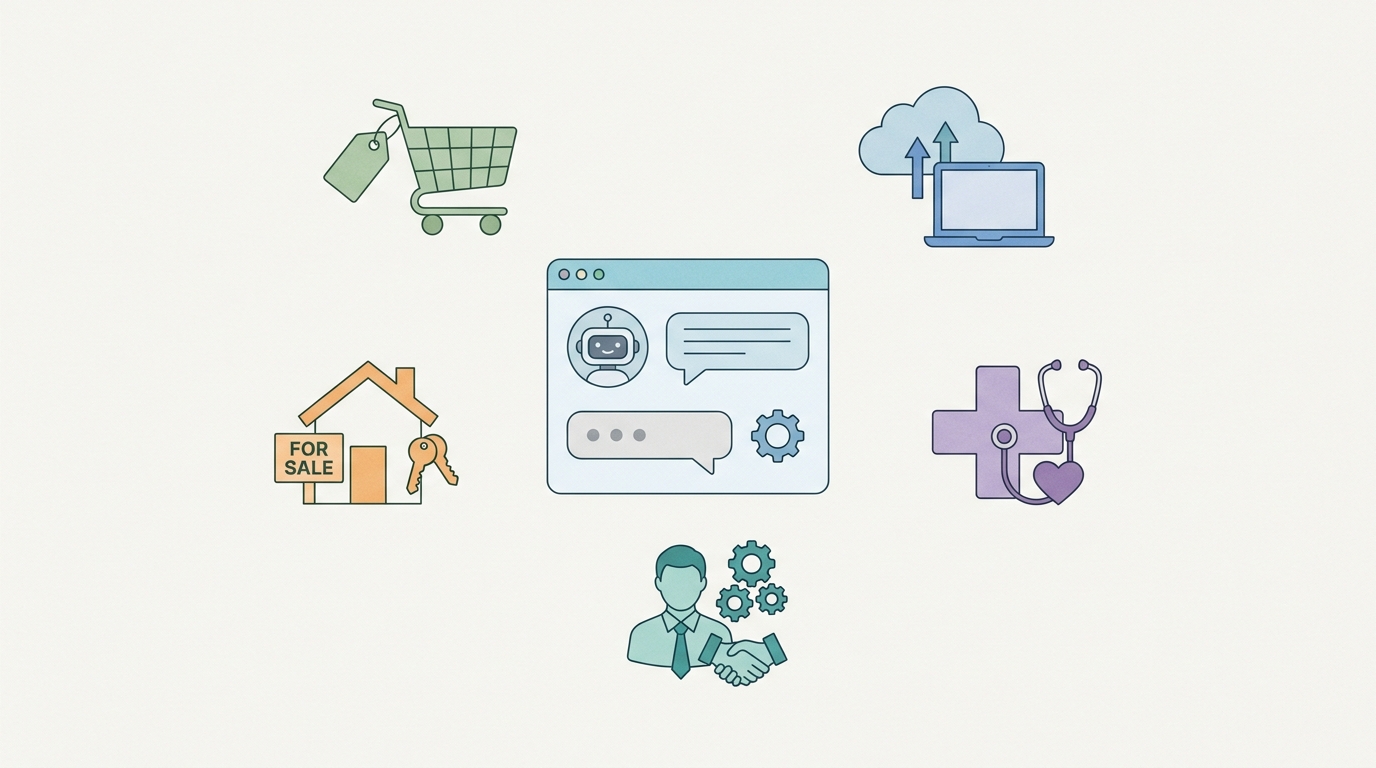
AI chatbots are deployed across virtually every industry that operates a web presence. But the measurable impact is not evenly distributed. Some industries see transformational ROI from the first deployment. Others see modest gains. The difference is not the AI - it is how closely the industry's specific dynamics align with what AI chatbots are structurally designed to do well.
AI chatbots excel when the inquiry volume is high, the question patterns are predictable, the stakes of slow response are significant, and the need for human judgment is limited for the majority of interactions. Industries that exhibit all four of these characteristics simultaneously see the largest returns.
This article examines the five industries where that convergence is strongest, with current performance benchmarks, specific use cases, and real implementation data from each sector.
The Framework for Evaluating Industry Fit
Before examining specific sectors, the evaluation criteria that determine AI chatbot value in any industry:
Volume: High inquiry volume means more automation opportunity and faster ROI payback.
Pattern concentration: Industries where 10-20 question types account for 60-80% of inquiries automate more completely than industries with highly heterogeneous inquiry patterns.
Response time sensitivity: Industries where delayed responses cost measurable revenue or relationships see higher returns from 24/7 availability.
Decision support value: Industries where prospects need real-time information to make purchasing decisions benefit from chatbot-as-sales-tool, not just chatbot-as-support-tool.
Compliance constraints: Industries with strict regulatory requirements (healthcare, finance, legal) require more careful scoping of what the chatbot can and cannot address.
The five industries below score highest across these dimensions.
Average Response Time Without AI Chatbot (Hours)
AI chatbots reduce all of these to under 4 minutes
1. E-Commerce and Retail
E-commerce is the highest-density use case for AI chatbots - a combination of massive inquiry volume, highly predictable question patterns, direct revenue impact, and 24/7 operation requirements that human teams cannot match cost-effectively.
Why E-Commerce Benefits Most
The e-commerce inquiry environment is structurally ideal for AI:
- Order status (WISMO) accounts for 20-40% of all inbound support inquiries across retail - a single question type with a lookup answer
- Return and refund policy questions represent 10-15% of orders in apparel and home goods
- Product questions (sizing, compatibility, availability) are high-volume and answerable from catalog data
- Cart abandonment - 75.38% of all online carts - is addressable through proactive AI engagement at the moment of exit
What the Data Shows
- AI chatbots in e-commerce deflect 40-80% of inbound support inquiries
- Shoppers assisted by AI chatbots convert at 12.3% vs. 3.1% for unassisted visitors - a 4x lift
- Cart recovery through proactive chat: 35% of abandoned carts recovered vs. email-only sequences
- Average AI chatbot ROI in e-commerce: 340% in the first year, with payback in 3-6 months (Gartner)
- Stores using AI chatbots see 15-35% conversion lifts from product recommendation engines
- WooCommerce stores using AI chatbots report 45% fewer support tickets
- Cost per AI-handled interaction: $0.25-2.00 vs. $8-15 for human agents in US/UK markets
Key Use Cases
Proactive cart recovery: Triggered when a visitor adds to cart but shows exit-intent signals. The chatbot surfaces a personalized message - "Still deciding? I can answer any questions about this item or check if there are any active promotions" - and intercepts abandonment in real time.
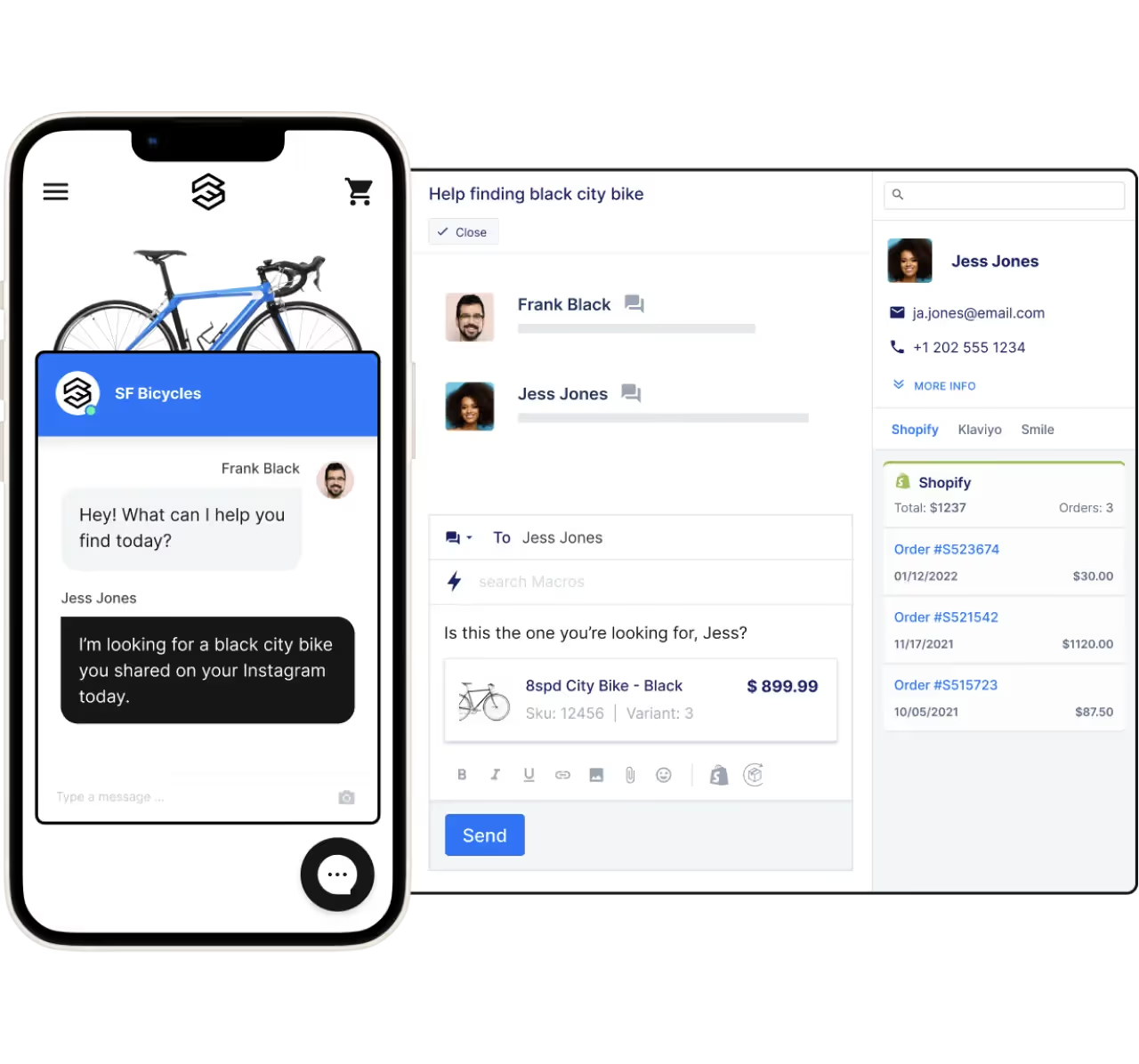
WISMO automation: Integrated with the store platform (Shopify, WooCommerce) and shipping provider (AfterShip, ShipStation), the chatbot retrieves real-time order status without any human involvement.
Return initiation: The chatbot walks customers through return eligibility, generates return labels, and confirms receipt - turning a 3-5 minute phone call or 24-48 hour email exchange into a 60-second chat interaction.
Post-purchase upsell: AI analyzes purchase history and surfaces relevant recommendations during post-purchase support conversations - turning support interactions into additional revenue opportunities.
2. SaaS and Technology Companies
SaaS companies face a distinctive challenge: their customer base is technically sophisticated, their product is complex, and their support volume scales directly with growth - creating a structural tension between growth ambition and support costs.
AI chatbots resolve this tension by handling the high-volume, low-complexity tier of support at scale, allowing human support specialists to focus on the complex issues that require deep product knowledge and engineering access.
Why SaaS Benefits Significantly
SaaS inquiry patterns have several characteristics that strongly favor AI:
- Account management issues (password resets, team invitations, permission changes) account for 15-25% of total ticket volume - all procedural, all automatable
- Billing questions (invoice access, upgrade/downgrade, payment method changes) represent another 10-20%
- Feature discovery is a consistent source of high volume: customers who do not know a feature exists ask about it in support rather than finding it in documentation
- Integration and API questions are frequent during evaluation and onboarding - answerable from documentation without customization
What the Data Shows
- SaaS companies using AI chatbots reduce after-hours staffing costs by 70-80%
- First response time drops from 6+ hours to under 4 minutes with AI-powered support (Pylon, 2025)
- AI chatbots reduce customer churn by 15-25% by providing instant responses to pre-churn frustration signals
- 64% of agents can focus on complex problems when AI handles tier-one support vs. only 50% without AI
- SaaS companies with AI chatbots report up to 30% improvement in first-contact resolution
- Human agents resolve 14% more issues per hour when AI handles routine tier-one support
Key Use Cases
Onboarding acceleration: New users who cannot figure out how to complete a setup step are a churn risk in the first 7-14 days. A chatbot that answers onboarding questions instantly - including walking through specific configuration steps - keeps users moving through activation rather than disengaging.
Trial conversion support: Free trial users who are close to a purchase decision often have specific evaluation questions. An AI chatbot that can answer integration questions, pricing details, and feature comparisons in the chat interface converts more trials than a form that promises a sales callback.
Churn prevention: When a user asks about cancellation, the chatbot can respond with the cancellation path (clearly, as required) but also surface relevant alternatives - pause options, downgrade tiers, or an offer to connect with the customer success team for accounts that meet specific criteria.
Paperchat itself exemplifies this pattern in SaaS: the platform provides instant answers to the evaluation and onboarding questions that would otherwise reach a support queue, freeing the team to focus on strategic customer success work.
3. Real Estate
Real estate is an industry where 24/7 lead responsiveness is not a competitive advantage - it is the baseline requirement. Buyers and renters operate on schedules that do not match business hours, and the window between a prospect's first interest and their decision to engage seriously is measured in hours, not days.
Traditional real estate websites capture leads through contact forms that may sit unread for hours. AI chatbots engage the same visitor in real time, qualify their interest, collect detailed information about what they are looking for, and schedule viewings - all without human involvement.
Why Real Estate Benefits Strongly
The real estate inquiry environment has several characteristics that strongly favor AI:
- Lead qualification is highly structured: buyers and renters answer predictable questions (budget, timeline, location preferences, size requirements, financing status) that map directly to a chatbot qualification sequence
- Response speed is a primary differentiator: NAR data shows that 78% of buyers choose the first agent who responds substantively
- Evening and weekend lead volume is disproportionately high: real estate research happens outside business hours, when human agents are unavailable
- Property information questions are answerable from listing data: AI can answer availability, pricing, square footage, amenities, and nearby points of interest without any human involvement
What the Data Shows
- 80% of property inquiries occur outside standard business hours (Zillow, 2024)
- AI chatbots in real estate generate 5x more leads than contact forms alone
- Real estate teams using AI chatbots report 50-60% reduction in manual lead qualification time
- Properties using AI chat for inquiry handling see 25-35% more viewing appointments scheduled
- Average response time drops from 5+ hours to under 2 minutes with AI chatbots
- AI-qualified real estate leads convert to viewings at 3x the rate of unqualified form submissions
- Real estate agencies using AI report 40% lower cost per qualified lead
Key Use Cases
24/7 inquiry handling: A prospect browsing listings at 10pm on a Sunday receives immediate, detailed responses about property availability, pricing, and scheduling options - rather than a form submission confirmation that promises a callback "within 1-2 business days."
Conversational lead qualification: The chatbot conducts a structured qualification conversation - budget range, desired location, size requirements, timeline, financing pre-approval status - and scores leads against the agency's ICP before a single human minute is spent.
Viewing scheduling: AI integrated with a calendar tool (Cal.com, Calendly) can book viewings directly within the chat conversation, converting interested leads to confirmed appointments in real time.
Neighborhood and listing information: AI trained on listing data and neighborhood information can answer the full range of pre-inquiry questions - school districts, commute times, nearby amenities, recent comparable sales - that buyers research before making contact.
4. Healthcare and Wellness
Healthcare is among the most sensitive industries for AI deployment, but it is also among the highest-volume, and the gap between what AI can appropriately handle and what it cannot is more clearly defined than in most sectors.
AI chatbots in healthcare are not advisors - they are administrative and informational tools. The scope is: appointment scheduling, FAQs about services and procedures, insurance and billing questions, location and hours, and prescription refill request routing. Within that scope, the volume and impact opportunity is substantial.
Why Healthcare Benefits with Appropriate Scoping
- Appointment scheduling and reminders represent the single largest administrative cost in most healthcare practices
- Insurance coverage and billing questions are high-volume and follow predictable patterns
- After-hours questions - services available, urgent care guidance, location and hours - are a patient satisfaction bottleneck that AI can address without clinical risk
- Pre-appointment information (preparation instructions, what to bring, what to expect) can be delivered by chatbot with high accuracy and significantly reduces no-shows
What the Data Shows
- AI chatbots reduce healthcare appointment no-show rates by 26-28% through automated reminders and preparation guidance (MGMA, 2025)
- Healthcare organizations using AI chatbots see 60-70% reduction in administrative call volume
- Patient satisfaction scores improve by 20-30% when AI handles administrative questions instantly rather than routing to phone queues
- AI chatbots reduce healthcare operational costs by 30-40% through administrative automation
- Healthcare chatbot interactions are expected to save $3.6 billion in healthcare costs by 2026 (Juniper Research)
- 64% of patients are comfortable using AI chatbots for administrative healthcare tasks
Key Use Cases
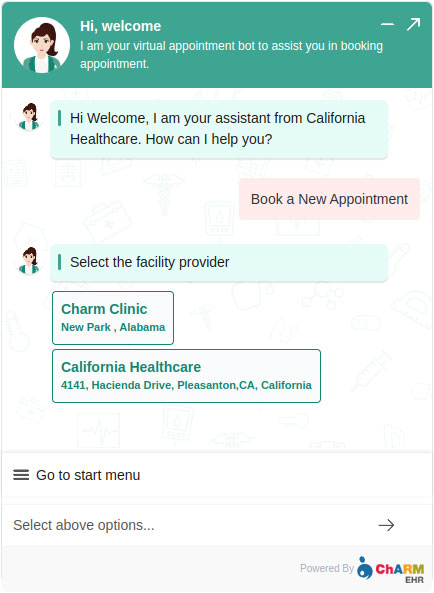
Appointment booking and management: Integrated with the practice management system, the AI chatbot handles new appointment requests, reschedules, and cancellations without requiring phone contact. For high-volume practices, this eliminates one of the largest staffing costs.
FAQ about services and procedures: What does a specific procedure involve? How should patients prepare for a procedure? What does post-procedure recovery look like? These questions arrive in high volumes and have standardized answers that the chatbot can provide accurately from the practice's documentation.
Insurance and billing pre-screening: The chatbot can answer common insurance questions (which insurers are accepted, how to check coverage, what the billing process looks like) and collect insurance information before the appointment, reducing administrative time at check-in.
After-hours triage guidance: While clinical advice requires a human, after-hours guidance on whether a situation warrants urgent care, the ER, or can wait until morning is a legitimate and valuable AI use case - when scoped to general information rather than individual clinical assessment.
Compliance Considerations
Healthcare AI deployments must account for HIPAA requirements around patient data handling, and scoping is critical: AI should not provide individualized medical advice, interpret test results, or make clinical recommendations. Platforms that offer HIPAA-compliant infrastructure and clear scope configuration are essential for this sector.
5. Professional Services and Agencies
Professional services - consulting firms, law firms, marketing agencies, accounting practices, financial advisors - operate on a model where client relationships are the core asset, but the administrative burden of managing new inquiries, qualifying prospects, and onboarding clients consumes a disproportionate share of billable time.
AI chatbots address this by handling the front end of the client acquisition funnel: answering inquiry questions, qualifying prospect fit, scheduling discovery calls, and collecting the information that makes the first human conversation immediately productive.
Why Professional Services Benefits Measurably
- Discovery calls are a significant time cost for most professional services firms, and most firms do not systematically qualify whether a prospect is a good fit before scheduling them
- Service and scope questions are answered repeatedly by senior staff who could be billing that time
- Prospect response time is a primary differentiator in competitive professional services markets - the first firm to respond substantively often wins
- Lead intake and qualification involves collecting the same information from every prospect - a highly automatable process
What the Data Shows
- Professional services firms using AI chatbots report 40-60% reduction in unqualified discovery calls
- AI chat generates 3x more qualified inquiries than contact forms for professional services websites
- Law firms using AI chatbots increase intake volume by 50-150% without adding staff
- Average discovery call length decreases by 30-40% when AI pre-qualifies leads with structured intake questions
- Financial advisory firms using AI chatbots see 25% higher lead-to-client conversion rates
- Agency clients using AI chatbots report 35-40% reduction in new client onboarding time
Key Use Cases
Prospect qualification: The chatbot conducts a structured qualification conversation - service needed, timeline, budget range, current situation, specific goals - and identifies whether the prospect meets the firm's client criteria before any human time is invested.
Instant service information: Questions about service scope, typical engagement structure, pricing approach, and past work experience are answered immediately rather than requiring a follow-up email or discovery call to get basic information.
Discovery call scheduling: AI integrated with a calendar tool schedules discovery calls directly within the chat conversation, eliminating the back-and-forth email exchange that typically delays the first conversation by 48-96 hours.
Content and expertise delivery: For firms with significant content libraries - guides, case studies, research reports - the chatbot serves as a content concierge: matching visitor interest to relevant resources and capturing contact information as part of the delivery.
Industry Comparison
| Industry | Primary Use Case | Avg. Deflection Rate | Revenue Impact | Compliance Complexity |
|---|---|---|---|---|
| E-Commerce | WISMO + cart recovery | 40-80% | Direct (conversion + recovery) | Low |
| SaaS | Tier-1 support + trial conversion | 50-75% | Direct (reduced churn + trial conversion) | Low-Medium |
| Real Estate | Lead qualification + scheduling | 60-80% (inquiries) | Direct (lead volume + conversion) | Low |
| Healthcare | Appointment + admin | 40-70% (admin volume) | Indirect (cost reduction + satisfaction) | High |
| Professional Services | Lead qualification + intake | 50-70% (inquiries) | Direct (qualified lead volume) | Medium |
AI Chatbot Inquiry Deflection Rates by Industry
Average deflection/automation rates across high-fit sectors
Industries with Lower Natural Fit
For completeness, several industries see more limited returns from AI chatbot deployment:
Manufacturing and B2B industrial: Inquiry patterns are heterogeneous, deal cycles are long, and most substantive questions require engineering or sales expertise. AI handles basic inquiry routing and product information effectively but has limited scope for full resolution.
High-touch luxury retail: The customer expectation is personalized human service. AI can handle operational questions (hours, location, order status) but deploying AI in the primary customer conversation channel risks damaging the brand positioning.
Government and public sector: Volume is high but the nature of inquiries is often complex, multi-step, and sensitive. AI handles FAQs and appointment scheduling effectively; case-specific assistance typically requires human agents.
These industries are not poor candidates for AI - they are candidates for more carefully scoped implementations rather than broad conversational AI deployment.
Choosing the Right AI Chatbot for Your Industry
Regardless of which of the five high-fit industries applies to your business, the implementation principles that drive the highest returns are consistent:
- Train on your specific content, not generic industry knowledge - the chatbot's accuracy advantage comes from knowing your products, policies, and services precisely
- Integrate with the backend systems that answer the most common questions - order management, booking systems, CRM - because connection to live data is what enables genuine resolution vs. generic information
- Define a clear escalation scope for your industry's specific sensitive areas - clinical advice in healthcare, legal advice in professional services, complex disputes in e-commerce
- Measure deflection and resolution rates by question category from day one - this tells you exactly where to focus training improvements
More Articles
8 Ways AI Chatbots Reduce Support Ticket Volume
A detailed breakdown of how AI chatbots cut inbound support ticket volume, with current performance benchmarks, real case studies, and practical guidance on implementation.
April 8, 2026
5 Best AI Chatbot Integrations for E-Commerce Stores in 2026
A detailed guide to the AI chatbot integrations that deliver the most impact for e-commerce stores, with performance data, setup complexity, and real-world case studies.
April 8, 2026