

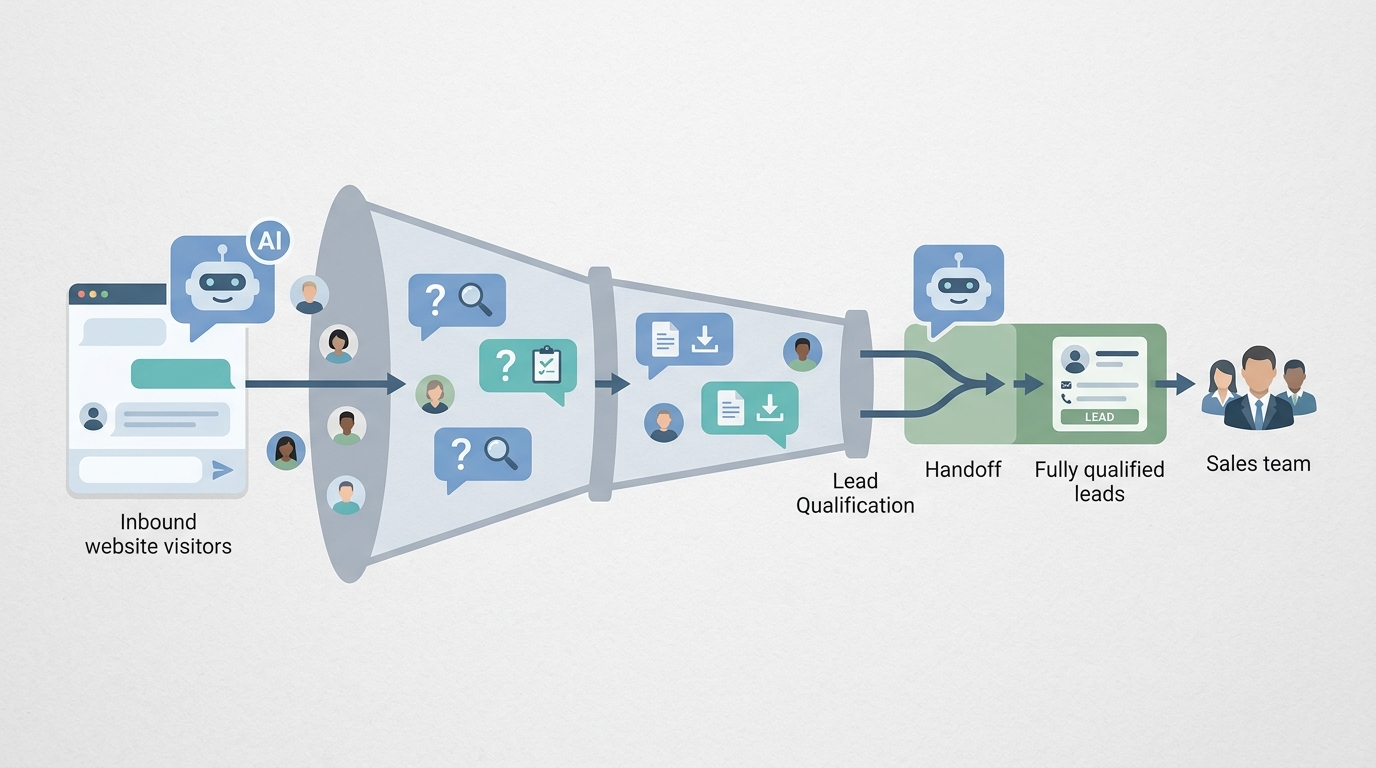
Most businesses that deploy an AI chatbot on their website are thinking about deflection: fewer support tickets, faster response times, lower costs. That is a legitimate goal, and AI does it well.
But the same infrastructure that handles support also sits at the top of your sales funnel, engaging every visitor who shows up on your site - including the ones who have never been a customer, have never submitted a ticket, and are actively trying to decide whether to buy.
Lead generation is the use case most AI chatbot deployments leave on the table.
This article covers six specific mechanisms through which AI chatbots generate leads - not as a side effect of support automation, but as a primary, measurable outcome - with current benchmarks, real-world case studies, and implementation notes for each.
Why AI Chatbots and Lead Generation Are a Natural Pairing
Before examining the mechanisms, the numbers that establish the opportunity:
- AI chatbots generate 3x more leads than traditional web forms (Drift, 2025)
- Businesses using AI chatbots for lead capture report 67% more leads per month on average
- Chatbot-assisted leads convert at 4x higher rates than cold leads because they arrive with context
- Response time matters enormously at this stage: 78% of buyers choose the vendor that responds first (Lead Response Management study), and AI responds in under 3 seconds
- 35% of business leaders say AI chatbots have helped close more deals (Intercom, 2025)
- Live chat generates 4-8x more pipeline than forms alone (Drift benchmark data)
The core advantage is timing. A form captures a lead and waits for someone to follow up - sometimes hours later, sometimes the next day. A chatbot captures a lead and initiates the qualification conversation in the same session, when intent is highest.
1. Proactive Engagement Based on Behavioral Signals
The first and most immediate lead generation mechanism is not reactive - it is proactive. Rather than waiting for a visitor to seek out the chat widget, an AI chatbot can monitor behavioral signals and initiate a conversation when intent is high.
A visitor who has spent 90 seconds on the pricing page is signaling something. A visitor who has navigated from the homepage to the features page to the comparison page is showing buying intent without having said a word. A visitor who is on their third visit in four days is closer to a decision than a first-time viewer.
Proactive chat triggered by these signals outperforms generic greeting messages by a significant margin.
What the data shows:
- Proactive chat converts visitors into leads at 3-5x the rate of passive chat widgets
- Website visitors engaged by proactive chat are 82% more likely to become customers (Kayako)
- Triggered messages (behavior-based) generate 20-30% conversion lifts vs. time-based triggers
- Personalized proactive chat increases conversion by 10-15% over generic openers (Forrester)
- 44% of online consumers say they want live/chat assistance when navigating a purchasing decision
How to implement:
Define specific behavioral triggers relevant to your sales funnel. High-intent triggers typically include: pricing page visits over 45 seconds, return visits within 7 days, navigation from product pages to comparison pages, exit-intent on the checkout or signup page, and time-on-page thresholds for high-value content.
The opener matters. "Can I help you?" performs poorly. "I noticed you're exploring our pricing - would a quick comparison of the plans be helpful?" performs significantly better because it is specific and demonstrates value immediately.
2. Conversational Lead Qualification
Traditional lead generation collects contact information and passes it to sales. Conversational lead qualification goes further: the AI gathers the information that determines whether a contact is worth pursuing, and scores or segments it before it reaches the CRM.
The qualification conversation is one AI does consistently well. It asks the same questions to every lead, in a sequence that feels natural rather than interrogative, and captures the responses in a structured format that integrates directly into the sales workflow.
What the data shows:
- Conversational qualification increases sales-qualified lead (SQL) rates by 35-50% over unqualified form submissions
- Sales teams using AI-qualified leads close 36% more deals per quarter (Salesforce, 2025)
- AI chatbots engage website visitors for an average of 6+ minutes - enough to run a full qualification sequence
- 60% of leads that enter an AI qualification conversation provide more detailed information than they would on a form (Aberdeen Research)
- AI qualification sequences reduce sales team time spent on unqualified leads by 73%
How to implement:
Build a qualification sequence that maps to your ICP criteria. The sequence typically asks: what problem are you trying to solve, what is your current solution, what is your timeline, what is the decision-making process, and what would make you move forward. The AI extracts and structures this data, scores the lead against your criteria, and routes it appropriately.
The critical design principle is conversational pacing. A chatbot that asks five qualification questions in a row reads like a form with a chat interface. Good qualification sequences interleave questions with acknowledgments, follow-up prompts, and value statements - keeping the visitor engaged rather than feeling interrogated.
3. Content and Gated-Asset Delivery
Content marketing generates enormous top-of-funnel interest - blog readers, video viewers, guide downloaders, webinar registrants. Most of this interest is captured through forms that ask for an email address in exchange for a resource and then drop the prospect into an email sequence that may or may not resonate.
AI chatbots allow content delivery to happen inside a conversation - with immediate follow-up, personalization, and qualification built into the same interaction.
What the data shows:
- Chatbot-gated content generates 47% more leads than static form gates (HubSpot, 2025)
- Email open rates for chatbot-delivered content follow-up sequences average 45-52% vs. 21% for standard email marketing
- Chatbot content delivery increases form completion rates by 40% by reducing friction
- Businesses using chatbot-driven content delivery report 3.3x more qualified leads from content programs
- Lead magnet campaigns using chatbots see average 4x ROI vs. email-gated content alone
How to implement:
The pattern is straightforward: a visitor reads a blog post or guide. The chatbot surfaces a relevant, related asset - "I see you're reading about AI chatbot setup. We have a full implementation checklist that most teams find useful - want me to send it over?" The visitor provides an email, receives the asset, and enters a follow-up sequence triggered by that specific content consumption.
The important difference from a form is the conversational context. The chatbot knows which page the visitor came from, can recommend assets that match the specific topic, and can immediately qualify the lead based on their response to the offer.
4. Exit-Intent Lead Recovery
Exit-intent mechanisms have historically been the domain of pop-up overlays, which most visitors have been conditioned to close without reading. A conversational exit-intent prompt - delivered as a chat message rather than a modal - performs significantly better.
When a visitor is about to leave without converting, the chatbot has a brief window to either capture contact information, provide the information that was missing, or change the conversion outcome.
What the data shows:
- Exit-intent chat messages recover 10-15% of visitors who would otherwise leave without converting
- Chatbot exit-intent prompts convert at 3-5x the rate of traditional exit-intent pop-ups
- The most effective exit-intent offer is one specific to what the visitor was looking at - not a generic discount
- Abandoned checkout recovery through chat captures 15-25% of carts that email alone cannot recover
- 49% of visitors who receive a personalized exit-intent message engage with it
How to implement:
Trigger the exit-intent message when the mouse moves toward the browser's close button or navigation bar, or when inactivity exceeds a threshold on a high-intent page. The message should be specific: "Before you go - we noticed you spent time on our enterprise pricing. Is there a specific question I can answer?" or "Most teams that don't move forward are comparing us to [Competitor X] - can I share a quick comparison?"
The goal at this stage is not necessarily to convert - it is to capture enough contact information to enable a follow-up, or to surface the specific objection blocking conversion so it can be addressed.
5. Post-Chat Lead Nurturing Sequences
A lead captured in chat does not end at the conversation. The AI interaction generates a rich set of data - what the visitor was interested in, what questions they asked, what content they engaged with, what objections they raised - that makes downstream nurturing dramatically more effective.
Traditional lead nurturing operates on basic segmentation: source, job title, company size. AI-assisted nurturing operates on behavioral and conversational signals: what the prospect actually said they needed, what stage of evaluation they were in, and what specific friction points they encountered.
What the data shows:
- Nurtured leads make 47% larger purchases than non-nurtured leads (Annuitas Group)
- AI chatbot-collected data improves email marketing relevance scores by 55-70% vs. form-only data
- Personalized nurture sequences based on chat transcripts generate 36% more qualified opportunities
- Companies using chat-informed nurturing see 25-35% higher SQLs per month from the same inbound volume
- Email sequences triggered by specific chatbot interactions convert at 3-4x the rate of generic drip sequences
How to implement:
Map your chatbot conversation outcomes to specific nurture tracks. A visitor who asked detailed pricing questions goes into a sales-ready nurture track. A visitor who asked about integrations goes into a technical evaluation track. A visitor who mentioned they were at an early research stage goes into a long-form educational track.
Platforms like Paperchat expose these conversation outcomes as structured data through webhook events, which connect directly to HubSpot, Klaviyo, ActiveCampaign, or any CRM or marketing automation platform - enabling the nurture sequence to fire in real time with full context, not just a name and email.
6. Human Handover at the Peak of Intent
The final mechanism is not about automating the lead generation process - it is about knowing when to stop automating it. A visitor who is deeply engaged in a chatbot conversation about pricing, implementation, or a specific use case is at their highest point of intent. This is the moment the AI should hand off to a human sales representative, not continue the automated interaction.
AI-to-human handover for lead generation is distinct from AI-to-human handover for support. In support, escalation is typically triggered by complexity or frustration. In sales, it is triggered by readiness: signals that indicate the prospect is close to a decision and would benefit from a direct human conversation.
What the data shows:
- Leads that receive a human handover within 5 minutes of a high-intent signal convert at 9x higher rates (Lead Response Management Institute)
- AI chatbots with intelligent human handover generate 40% higher conversion rates than fully automated flows
- Real-time sales notifications from chat produce 47% more pipeline per sales rep
- Chatbot-to-human handover sales interactions have 34% higher close rates than cold outreach
- 61% of B2B buyers want to speak with a human before making a purchase decision
How to implement:
Define the signals that constitute "sales-ready" in your specific context. Common signals include: request for a demo or trial, direct pricing question with a specific budget range, mention of an evaluation deadline, or repeated engagement with high-intent content in a short window.
When these signals appear, the AI should do three things: alert the relevant sales representative in real time (via Slack, email, or CRM notification), immediately offer to connect the prospect with a human ("It sounds like you're evaluating this seriously - can I connect you with one of our team members right now?"), and pass the full conversation context to the human agent so they are not starting from zero.
Lead Generation vs. Support Automation: The Comparison
| Dimension | Support Automation | Lead Generation |
|---|---|---|
| Trigger | Customer query | Visitor behavior |
| Primary goal | Deflect tickets | Capture + qualify leads |
| Conversation pattern | Reactive | Proactive |
| Success metric | Deflection rate | Lead conversion rate |
| Downstream system | Helpdesk / ticketing | CRM / sales pipeline |
| Handover trigger | Complexity or frustration | Purchase intent |
| Average ROI (12 months) | 2-5x cost savings | 3-8x revenue impact |
Building a Lead Generation Chatbot: Sequencing the Setup
Most businesses should implement lead generation capabilities in stages rather than simultaneously:
Stage 1 (Week 1-2): Deploy the chatbot with knowledge base trained on your product, pricing, and FAQ content. Enable passive lead capture - a name and email ask before or after a substantive conversation.
Stage 2 (Week 3-4): Add proactive triggers on high-intent pages (pricing, features, comparison). Build a basic qualification sequence. Connect to CRM.
Stage 3 (Month 2): Add content-gated assets for chatbot delivery. Build exit-intent prompts for key conversion pages. Configure sales notifications for high-intent signals.
Stage 4 (Month 3+): Optimize based on conversion data. Refine trigger logic, qualification questions, and nurture sequences based on what has actually been working.
The businesses seeing 3-8x lead generation ROI from AI chat are not running more sophisticated technology than everyone else. They are running more intentional implementations - with clear goals, defined funnels, and continuous measurement.
More Articles
How to Capture More Leads with an AI Chat Widget on Your Website
Turn passive website visitors into qualified leads using Paperchat's AI chat widget — with proactive messaging, lead forms, and CRM sync.
March 29, 2026
10 Customer Support Tasks You Can Automate with an AI Chatbot Today
A detailed breakdown of the customer support tasks AI chatbots handle best — with data, real examples, and guidance on where human agents still matter.
April 8, 2026