
AI Chat for Real Estate: Qualify Leads 24/7 Without Hiring Staff
Real estate agents miss 80% of inquiries that arrive outside business hours - AI chatbots solve the response gap while delivering pre-qualified, appointment-ready leads.

Stan
@stan
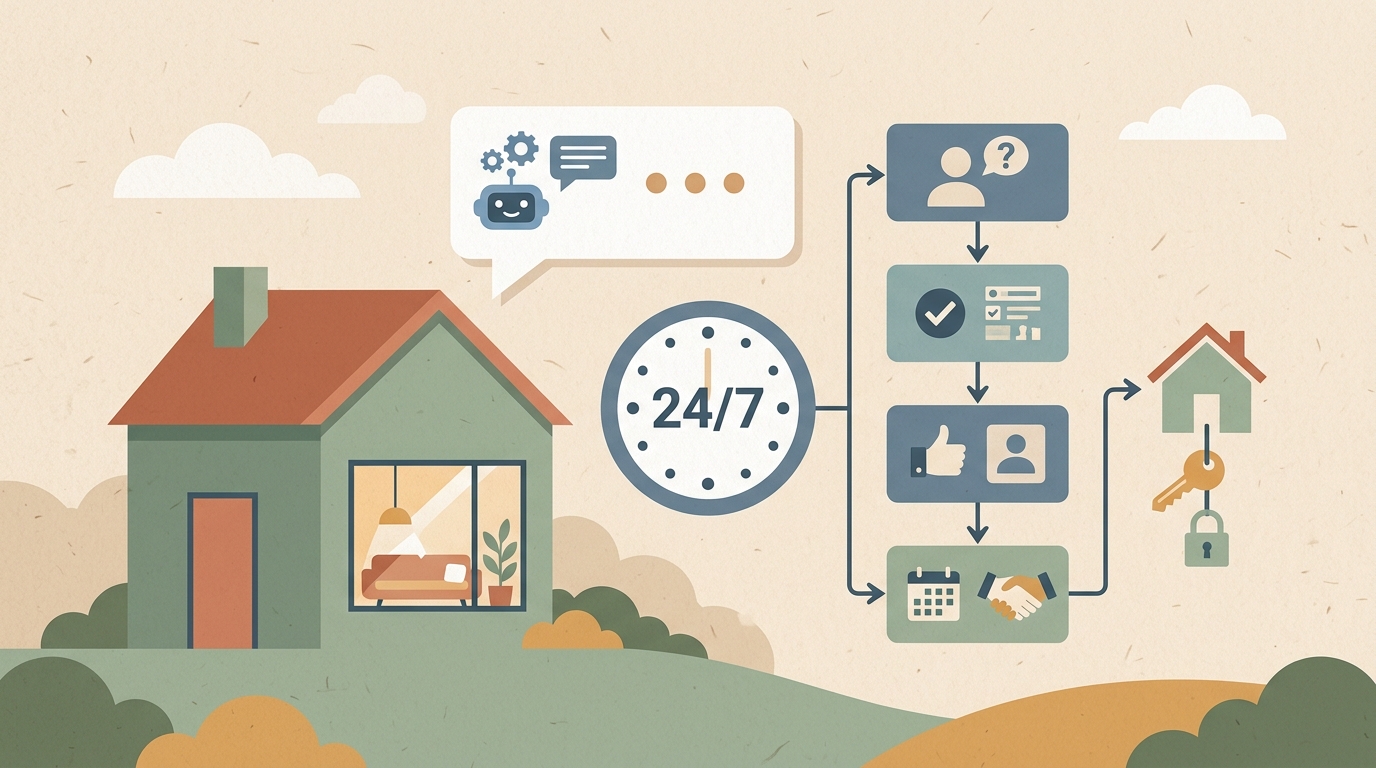
The economics of real estate lead generation have never made less sense. Agents and brokerages spend heavily on Zillow listings, Google Ads, social media advertising, and portal placement to drive traffic to their websites and property pages. Those campaigns generate inquiries around the clock. The agents who are supposed to respond to those inquiries work a standard business day. The gap between the two - between when inquiries arrive and when agents respond - destroys a majority of the investment.
Zillow's 2024 Consumer Housing Trends Report found that 80% of property inquiries are submitted outside standard business hours. The National Association of Realtors' data on agent response behavior shows that the average online lead response time for real estate professionals is 5 or more hours. Research on buyer behavior shows that most online leads go cold within 5 minutes of submitting an inquiry if they receive no acknowledgment.
These three facts in combination explain a great deal about why real estate lead economics are so punishing. The industry has optimized heavily for lead generation and almost not at all for lead capture - the critical window between when a prospect expresses interest and when a qualified conversation begins.
AI chat changes this equation fundamentally. Not incrementally - fundamentally. The difference between a 5-minute response and a 5-hour response is not a 60x improvement in response time. Based on NAR data showing that 78% of buyers choose the first agent who responds substantively, the difference is winning or losing the client.
The Real Estate Lead Problem in Detail
Understanding the scale of the opportunity requires a clear picture of where current lead management fails.
The Response Time Collapse
Lead conversion research across industries consistently documents an inverse relationship between response time and conversion probability. In real estate, this relationship is particularly steep because the buying decision is time-sensitive (properties sell, prices change, interest rates fluctuate) and the market for buyer representation is competitive (every buyer can be working with multiple agents simultaneously until they commit).
Real Estate Lead Conversion Rate by Response Time
How quickly you respond determines whether you win the lead
Sources: NAR Real Estate in a Digital Age; Zillow Consumer Housing Trends Report, 2024
A prospect who submits an inquiry and receives a substantive response within five minutes converts to a viewing appointment at more than 12 times the rate of a prospect who waits five or more hours. This is not a fringe academic finding - it has been replicated across multiple studies and reflects a basic psychological reality: when people make a decision to reach out, they are in a specific mental state of active consideration. Every minute that passes without a response degrades that state.
The contact form, the dominant lead capture mechanism on real estate websites, makes this problem worse. A form submission is a cold, asynchronous communication. It offers no immediate confirmation, no conversational engagement, and no information exchange. The prospect submits their details and then waits - for an indeterminate amount of time, with no indication of what will happen next. By the time an agent calls, the prospect has likely submitted inquiries to three other agents and may have already had a conversation with one of them.
The Qualification Gap
The second problem compounding the response time issue is qualification quality. When an agent finally does respond to a form inquiry, they typically have minimal information to work with: a name, an email address, and whatever the prospect wrote in a free-text field. This forces the agent to spend their first conversation gathering basic qualification data that could have been collected automatically.
Meanwhile, agents working from portals like Zillow and Realtor.com receive a high volume of inquiries that include many low-intent prospects: people in early research phases, investors doing market scans, and curiosity browsers who will not transact for 12-24 months. Calling and qualifying every inquiry manually is time-prohibitive. Not qualifying means pursuing low-probability leads while high-intent buyers wait.
What AI Chatbots Do for Real Estate Lead Capture
24/7 Instant Response
The most immediate value an AI chatbot delivers in real estate is simply being present when no human is. A prospect who submits an inquiry at 10:30 PM receives a response in seconds - not a form confirmation email, but a genuine conversational response that acknowledges their specific inquiry and begins gathering information.
This immediate engagement serves three functions. First, it captures the prospect while their intent is at its peak. Second, it signals professionalism and responsiveness, which are among the most important factors buyers use when selecting an agent. Third, it begins the qualification process in real time, so that when the human agent picks up the conversation in the morning, they are starting from a position of knowledge rather than from zero.
AI chatbots in real estate typically generate 5 times more actionable leads than static contact forms alone according to a 2024 analysis by Real Estate Webmasters of 200+ agency websites. The improvement comes from a combination of higher engagement rates (prospects prefer conversation to form-filling), better qualification data collection, and the compounding effect of 24/7 availability capturing the after-hours inquiries that contact forms lose.
Structured Lead Qualification
The real estate qualification conversation has a predictable structure. Every buyer or renter inquiry can be meaningfully assessed on five dimensions:
Budget range - What price point is the prospect comfortable with? This single piece of information segments the prospect into a tier that determines which properties and agents are relevant.
Timeline - Is the prospect looking to move in 30 days or 12 months? High-intent, near-term buyers warrant immediate human follow-up. Research-phase prospects warrant a nurture sequence rather than high-frequency agent contact.
Location preference - Neighborhood, school district, commute radius. This determines which inventory is relevant and which agents have the relevant local expertise.
Property requirements - Type (single-family, condo, townhouse, multi-unit), bedrooms, bathrooms, must-have features. Essential for matching to available listings.
Financing status - Pre-approved, in process, or not yet started. Pre-approved buyers are significantly higher-intent than those still in the financing evaluation phase.
An AI chatbot can collect all five data points through a natural conversational flow that feels more like a helpful interaction than an interrogation. The questions are framed around the prospect's needs, not the agent's information requirements. "What neighborhood are you focusing on?" reads very differently to a prospect than "Location preference:" on a form.
Real estate teams using AI chatbots for qualification report 50-60% reduction in manual qualification time (Real Estate Technology Council, 2024) and, more importantly, the qualification data collected conversationally is more accurate and complete than form-submitted data.
Appointment Scheduling within the Chat
Qualifying a lead and then waiting for a human agent to schedule the viewing appointment introduces another abandonment risk. An engaged, qualified prospect in a chat conversation is in an active purchasing frame of mind. The right moment to book the viewing is now, in the chat, not in a follow-up email tomorrow.
AI chatbots integrated with calendar systems - such as Cal.com, which Paperchat supports natively - can present available viewing slots in real time and confirm appointments within the same conversation thread. The prospect selects a time, the chatbot confirms it, and both parties receive calendar invites automatically. The agent begins the next morning with a schedule of pre-qualified viewing appointments rather than a list of phone numbers to call.
Properties with AI chat-enabled appointment scheduling report 25-35% more viewing appointments per month than equivalent properties using contact-form-only inquiry management (Homeflow Real Estate Digital Marketing Report, 2024). The compounding effect is significant: more viewings per qualified lead, and more qualified leads per marketing dollar spent.
Property Matching and Inventory Navigation
Real estate websites with large inventory have a navigation problem. A prospect interested in "something in the $450,000-$550,000 range with good school ratings near the city center" cannot easily filter to that specific combination using standard search interfaces. They either narrow too aggressively and miss relevant properties, or browse an unmanageably large result set.
An AI chatbot trained on the agency's full property inventory can serve as a conversational property advisor. The prospect describes what they are looking for, the chatbot extracts the relevant parameters, and it surfaces the three or four properties that best match. This concierge-style experience is substantially more effective at driving engagement with specific listings than browse-based discovery.
The chatbot can also handle comparative questions - "What's the difference between these two properties?" - that buyers frequently have but rarely ask through formal channels. Answering these questions builds rapport and moves the prospect closer to a decision to view.
Neighborhood and Local Area Information
Property inquiries frequently include questions about the surrounding area that go beyond the listing itself: school district ratings and boundaries, commute times to specific destinations, walkability and transit access, planned development projects, neighborhood demographic and crime data, and local amenity proximity.
Agents who can answer these questions fluently come across as genuine local experts. Most of this information is static and documentable - it can be compiled into a chatbot knowledge base and served instantly to any prospect who asks. The chatbot becomes an ambient local expert, available at any hour, covering questions that most agents handle inconsistently depending on when they are asked and how well they happen to know a particular submarket.
Lead Qualification Framework
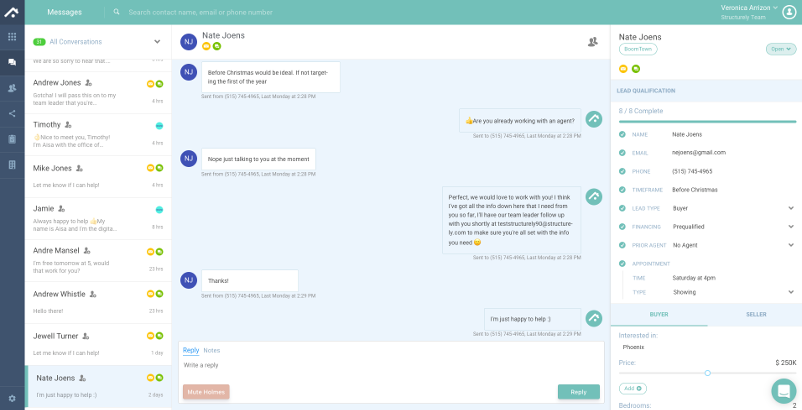
The Five-Question Qualification Sequence
A well-structured real estate chatbot qualification flow collects the core five data points through a sequence that feels natural to the prospect:
-
Opening contextualization: "Thanks for reaching out about [property/area]. Are you looking to buy or rent, and are you working with a specific timeline?"
-
Budget establishment: "To make sure I'm showing you relevant options, what price range are you comfortable working within?"
-
Location confirmation: "Are you focused specifically on [area mentioned], or are you open to nearby neighborhoods if we found something that fit your other criteria well?"
-
Property requirements: "What are your must-haves in terms of size and features - bedrooms, outdoor space, parking, anything you'd consider non-negotiable?"
-
Financing readiness: "Have you already been pre-approved for a mortgage, or are you still working through that process? I ask because it affects which options I can realistically show you quickly."
This sequence takes approximately three to four minutes in a conversational exchange and produces a complete qualification profile. The chatbot can branch based on answers - a prospect who is 12 months out receives a different follow-up path than one who needs to move in 45 days.
Lead Scoring and Segmentation
After collecting qualification data, the chatbot applies a scoring framework to segment leads:
| Score Tier | Criteria | Recommended Action |
|---|---|---|
| Hot (8-10) | Pre-approved, 0-60 day timeline, specific requirements, engaged in chat | Immediate agent notification, same-day callback |
| Warm (5-7) | In-process financing, 60-120 day timeline, defined preferences | Automated viewing invitation within 24 hours |
| Nurture (2-4) | Early research, 6+ month timeline, broad or undefined preferences | Enter email nurture sequence, monthly check-in |
| Cold (0-1) | No financing discussion, vague requirements, no response to qualification questions | Low-priority list, quarterly outreach |
The scoring thresholds should be calibrated to the agency's capacity. An agency with three agents handling 50 monthly leads cannot pursue every "warm" lead personally; an agency with twenty agents can. The key is that scoring happens automatically, before any human time is invested.
Human Handoff Criteria
The chatbot's role is qualification and initial engagement, not relationship management. Human handoff should happen when:
- The prospect reaches a "Hot" qualification score
- The prospect explicitly asks to speak with an agent
- The prospect asks a question outside the chatbot's knowledge base
- The conversation has been active for 15+ minutes without appointment booking (indicates a complex situation)
- The prospect mentions a competitor agency they are also working with
When handing off to a human agent, the chatbot should provide a complete briefing: qualification score, all collected data points, the specific properties the prospect expressed interest in, and any questions that were asked but not fully answered. The agent walks into the conversation informed rather than starting from scratch.
Implementation Guide
Step 1: Training the Chatbot on Your Inventory and Market
The chatbot knowledge base for a real estate agency should include:
- Current property listings (refreshed as inventory changes) including all specifications, pricing, features, and high-quality photos where possible
- Neighborhood profiles for every area the agency serves: school district ratings, commute benchmarks to major employment centers, walkability scores, notable amenities
- Agent bios and specialization areas (so the chatbot can match prospects to the right agent)
- Buying and renting process guides: what to expect at each stage, typical timelines
- Financing partners and pre-approval process information
- Agency policies: fees, representation agreements, what services are included
Update the knowledge base whenever listings change. A chatbot that presents inaccurate pricing or availability information damages the agency's credibility more than having no chatbot at all.
Step 2: Qualification Flow Design
Map out the qualification conversation flow before configuration. Decide:
- What questions are asked and in what order
- What branching logic applies (buyer vs. renter, purchase timeline, financing status)
- What the chatbot does at each qualification tier (book appointment, offer newsletter, escalate to human)
- What the chatbot does when it cannot answer a question (acknowledge, offer callback, capture email)
Test the flow with internal team members playing the role of prospects before going live. Identify any steps where the conversation feels unnatural or where prospects are likely to disengage.
Step 3: Calendar Integration
Connect the chatbot to the agency's scheduling system. The viewing booking flow should:
- Present available slots for the relevant agent or agents
- Confirm the specific property address and viewing format (in-person or virtual)
- Send calendar invites to both the prospect and the agent
- Send reminder messages 24 hours and 2 hours before the appointment
For multi-agent agencies, configure routing logic: which agents handle which territories or property types, and how availability is surfaced when the primary agent is unavailable.
Step 4: CRM Integration
Qualified lead data should flow automatically from the chatbot to the agency's CRM. The data transfer should include the full qualification profile, conversation transcript, lead score, and next action recommendation. Agents who receive a CRM entry with complete qualification data take higher-quality first calls and close appointments at higher rates than agents working from bare contact details.
Most modern CRM platforms support webhook integrations that can receive structured data from chatbot platforms. Agencies using tools like Paperchat can configure webhook delivery to push qualified lead data to their CRM in real time, triggering automated notification sequences for the assigned agent.
Contact Form vs. AI Chatbot: Performance Comparison
The performance differential between traditional contact forms and AI chatbot lead capture is consistent enough across deployments to be treated as a benchmark rather than an outlier.
| Metric | Contact Form | AI Chatbot | Improvement |
|---|---|---|---|
| After-hours lead capture rate | 20% (form submission only) | 95%+ | 4-5x |
| Average first response time | 5+ hours | Under 10 seconds | >1,800x |
| Qualification data completeness | 20-30% (basic form fields) | 85-95% (structured conversation) | 3-4x |
| Lead-to-viewing conversion rate | 8-12% | 28-38% | ~3x |
| Cost per qualified lead | $120-$200 (with follow-up labor) | $35-$65 | 40-60% lower |
| Appointment scheduling in initial interaction | Rarely (email/phone follow-up) | 45-65% of qualified leads | New capability |
The cost per qualified lead reduction deserves particular attention. Real estate agencies spend significant agent time manually following up on unqualified form leads - calling, emailing, texting prospects who submitted generic inquiries with minimal information. AI chatbot pre-qualification eliminates the majority of this follow-up labor by ensuring that leads reaching an agent are already scored and contextualized.
Data Handling and Compliance
Real estate chatbots collect personal information from prospects: names, contact details, financial information (budget ranges, financing status), and location preferences. This data is subject to privacy regulations that vary by jurisdiction.
GDPR (EU and UK): Prospects must be informed about data collection and its purpose before or at the point of collection. Consent must be explicit and freely given. Data must not be retained beyond its stated purpose. Agencies operating with GDPR jurisdiction must include a privacy notice in the chatbot initiation flow and provide a clear pathway for prospects to request data deletion.
CCPA (California): Similar requirements apply for California-based prospects. Disclosure of data collection practices and opt-out mechanisms are required.
Storage and access controls: Lead data collected through chatbot conversations should be stored in systems with appropriate access controls - accessible to the relevant agent and management, not to unrelated staff or third-party marketing systems without explicit consent.
Best practice is to include a brief disclosure at the start of the qualification conversation: "I'll be collecting some information about your property search to connect you with the right agent. Your details are handled according to our privacy policy." This disclosure satisfies regulatory requirements while framing the qualification process in terms of benefit to the prospect.
Agencies using platforms that comply with SOC 2 or ISO 27001 standards for data security can reference those certifications as part of the trust-building component of the chatbot interaction.
Benchmarks and Expected Outcomes
Real estate agencies with well-implemented AI chat lead qualification should target the following benchmarks within 90 days of deployment:
- After-hours lead capture: at least 80% of off-hours inquiries engaged in chat
- Qualification completion rate: 65-75% of chat conversations reaching all five qualification questions
- Hot lead identification rate: 20-30% of qualified prospects scoring as "Hot" (pre-approved, near-term timeline)
- Appointment booking rate: 40-55% of Hot leads booking a viewing within the chat session
- Agent time savings: 40% reduction in manual qualification calls per qualified lead delivered
These are achievable benchmarks for agencies that invest adequately in knowledge base quality and conversation flow design. The agencies that underperform relative to these targets almost always have the same root cause: a chatbot trained on thin content that cannot answer the product questions prospects actually ask, forcing excessive escalations that defeat the purpose of automation.
The real estate industry's lead economics are fundamentally broken by a response time problem that AI chat solves directly. Every hour that passes between inquiry submission and substantive response is an hour during which the prospect is engaging with competitors. The agencies that recognize this and close the response gap with AI infrastructure are not just improving efficiency - they are winning market share from peers who have not made the same investment.
More Articles
How to Capture More Leads with an AI Chat Widget on Your Website
Turn passive website visitors into qualified leads using Paperchat's AI chat widget — with proactive messaging, lead forms, and CRM sync.
March 29, 2026
6 Ways to Use an AI Chatbot for Lead Generation (Not Just Support)
Most businesses deploy AI chatbots for support. The ones winning on lead generation are using them differently. Here are six proven approaches backed by current data.
April 12, 2026
How to Use AI Chat to Book More Meetings with Cal.com
Connect Paperchat to Cal.com so your AI chatbot can qualify leads and book meetings directly in the chat window — without any back-and-forth emails.
March 29, 2026