
AI Chatbot vs. FAQ Page: Which Handles Customer Questions Better?
A research-backed comparison of AI chatbots and FAQ pages across resolution rates, user experience, SEO value, and cost - including when to use each and how to combine them.

Stan
@stan

Every business eventually reaches the same decision point: a support inbox that never empties, a team stretched thin answering the same 20 questions on repeat, and a website that technically has the answers somewhere - if only customers could find them. The FAQ page was the original solution to this problem. The AI chatbot is the more recent one. Both serve the same fundamental purpose - helping customers help themselves - but they do it in fundamentally different ways, and the performance gap between them on key metrics is larger than most businesses expect.
This article examines the evidence for both approaches: where FAQ pages still earn their place, where AI chatbots outperform them by a wide margin, and how the most effective support operations use both in combination.
The State of FAQ Pages in 2026
FAQ pages have existed for as long as websites have. They remain the most widely deployed self-service support tool across industries - and for understandable reasons. They require no ongoing technology subscription, no integration work, and no user onboarding. A customer motivated enough to seek out the FAQ page will often find what they need without any friction at all.
The research on customer preference for self-service is unambiguous: 70% of customers prefer to resolve issues themselves before contacting a support agent (Forrester, 2025). Zendesk's data reinforces this, finding that 91% of customers would use an online knowledge base if it were tailored to their needs. The demand for self-service is high. The question is whether the static FAQ page adequately meets it.
The evidence suggests it often does not. FAQ pages suffer from a structural problem: they are built around the questions companies anticipate, organized in ways that make sense to the people who wrote them, and navigated by users who have a completely different mental model of the problem they are trying to solve. The result is a 20-40% abandonment rate on FAQ pages, driven primarily by users who cannot locate the information they need, not by users whose question goes unanswered (Zendesk, 2025).
There is also the findability problem inside FAQ pages. Users scan, they do not read. They look for the exact phrase they have in their head, which is rarely the phrase the company used to describe the same thing. A customer searching for "how do I get a refund" may not immediately connect that to a section titled "Return and Exchange Policy."
Despite these limitations, FAQ pages generate substantial organic search value. Google indexes FAQ content aggressively, particularly when structured with schema markup. A well-written FAQ page can rank for hundreds of long-tail queries and drive significant traffic to a business's website - value that a chatbot, which operates primarily on-site and after a user has already arrived, cannot replicate.
What AI Chatbots Do Better
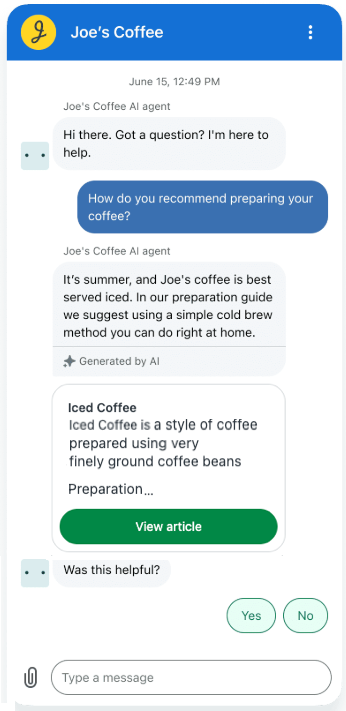
The performance differential between AI chatbots and static FAQ pages is most visible in resolution rate data. When Zendesk analyzed the same question sets handled by static FAQ pages and AI chatbots respectively, AI chatbots achieved a 78% resolution rate compared to 42% for static FAQ pages - nearly double (Zendesk, 2025). The gap comes from several structural advantages that chatbots have over static pages.
Conversational Format
A chatbot asks and answers. A FAQ page only answers. This distinction matters because most customer questions are not fully formed when they arrive. A customer asking "what are your shipping options?" may actually need to know whether express delivery is available to their specific region before a holiday deadline. A FAQ page presents general shipping information. A chatbot can ask "Where are you shipping to?" and "When do you need it to arrive?" and provide a specific, actionable answer.
This back-and-forth capability produces measurably different engagement. The average FAQ page session duration is approximately 1.8 minutes. AI chatbot sessions average 4.2 minutes with a 2.3x higher completion rate - meaning users are far more likely to get to a resolved answer rather than abandoning mid-journey (Zendesk, 2025).
Multi-Source Synthesis
A FAQ page is a flat document. An AI chatbot trained on multiple content sources - product documentation, pricing pages, shipping policies, return procedures, knowledge base articles - can synthesize information from across a company's content library into a single, coherent response. A customer asking about upgrading their subscription mid-cycle might need information from three separate policy documents. The chatbot delivers the combined answer; the FAQ page would require the user to find and read all three sections themselves.
24/7 Availability With Active Responses
Both FAQ pages and chatbots are technically available at any hour. But a FAQ page is passive - it waits for a customer to arrive, navigate, and find the right section. A chatbot is active. It can recognize when a user has been on a pricing page for 90 seconds without converting, and offer to answer questions. It can detect when a customer is on the returns page and proactively offer guidance. This proactive availability meaningfully reduces the rate at which browsing sessions turn into support tickets.
Lead Capture During Support
FAQ pages are pure cost centers in most implementations - they deflect support tickets but generate no revenue signal. An AI chatbot handling the same query can simultaneously identify the user's needs, capture contact information where the customer consents to provide it, and route qualified leads to a sales workflow. For businesses where support and sales overlap - a common scenario in SaaS, professional services, and e-commerce - this is a significant functional advantage.
Behavioral Analytics
Every conversation a chatbot has is a data point about what customers are actually asking. Over time this data reveals which questions arrive most frequently, which answers generate follow-up questions (indicating unsatisfactory resolution), and where users tend to drop off. A static FAQ page generates page view data; a chatbot generates intent data. The difference in actionability is substantial - chatbot analytics can drive continuous improvement to the knowledge base, to product documentation, and even to the product itself.
What FAQ Pages Still Do Well
The case for FAQ pages is not nostalgic. There are specific contexts in which a well-structured FAQ page outperforms a chatbot, and businesses that eliminate their FAQ pages entirely in favor of chatbot-only support often discover this the hard way.
SEO and Organic Discovery
This is the most defensible advantage of the FAQ page. A chatbot conversation leaves no indexable content. A FAQ page, particularly one structured with FAQ schema markup, can rank prominently in Google Search results - including as featured snippets and "People Also Ask" entries that appear before any organic result. For businesses that rely on search traffic for acquisition, the FAQ page serves double duty as both a support resource and an SEO asset.
The value compounds over time. A FAQ page published two years ago may be answering the same customer question from a Google search result. The SEO value of a chatbot conversation from two years ago is precisely zero.
Zero Friction for Motivated Users
Some users do not want to have a conversation. They want to find a specific piece of information, read it, and leave. Technical documentation, legal terms, pricing tiers, integration specifications - this is content that sophisticated users want to scan and cross-reference, not have paraphrased back to them in chat format. FAQ pages serve this user profile efficiently. A chatbot for these users can feel like an obstacle rather than an aid.
Research on user preference supports this nuance. Studies examining when users prefer FAQ pages over chatbots find that motivated, high-literacy users with specific technical questions consistently prefer scannable documentation over conversational interfaces (Nielsen Norman Group, 2024). The chatbot hesitation barrier - the brief friction of deciding whether to engage with a chat interface - is small but real, and it affects certain user profiles more than others.
Reliability for Technical Content
For complex technical content with many variables - developer documentation, integration guides, compliance requirements - FAQ pages allow users to read, re-read, copy specific values, and verify information at their own pace. A chatbot summarizing a complex integration procedure introduces the risk of omitting critical steps. A technical FAQ page, linked to from the chatbot when appropriate, provides the full content without abbreviation.
When Users Prefer FAQ vs. Chatbot
Research into user channel preference reveals a consistent pattern across query types (Forrester, 2024; Nielsen Norman Group, 2024):
Users prefer FAQ pages when:
- They already know what section they are looking for
- The question involves technical specifications they need to read carefully
- They are in research mode, comparing options across multiple criteria
- They have moderate-to-high domain familiarity and use precise terminology
- They want to copy or reference specific text (pricing, terms, API parameters)
Users prefer AI chatbots when:
- They are not sure which section of the FAQ would have the answer
- The question involves multiple variables specific to their situation
- They are experiencing a problem and need step-by-step guidance
- They are in a hurry and want a direct answer without navigation
- The query is emotionally charged (complaint, billing dispute, service failure)
- It is outside normal business hours and they expect no live support available
The intersection is notable: the queries that FAQ pages handle best are also the queries that chatbots are least likely to fumble. A motivated user who knows exactly what they are looking for will find it in a FAQ page efficiently. The queries that generate abandonment on FAQ pages - ambiguous, multi-variable, situation-specific - are exactly the queries where conversational AI demonstrates its largest performance advantage.
AI Chatbot vs. Static FAQ: Performance Comparison
Key support metrics — lower is better for Abandonment Rate (%)
Sources: Zendesk Customer Experience Report 2024; Freshworks CX Benchmark 2025; Forrester Self-Service Research 2024
Head-to-Head Comparison
| Dimension | AI Chatbot | FAQ Page |
|---|---|---|
| Resolution rate | 78% on common queries | 42% on same query set (Zendesk, 2025) |
| Average session duration | 4.2 minutes | 1.8 minutes |
| Completion rate | 2.3x higher than FAQ | Baseline |
| SEO value | None (on-site only) | High - ranks for long-tail queries |
| Setup cost | Medium - requires training data | Low - static content |
| Maintenance burden | Medium - knowledge base updates | Low-medium - periodic reviews |
| Personalization | High - adapts to user context | None - same answer for all users |
| 24/7 availability | Active and proactive | Passive only |
| Lead capture | Built-in capability | None |
| Analytics depth | Intent-level data | Page view data only |
| Mobile experience | Optimized conversational UI | Requires user to navigate long pages |
| User control | Guided by conversation flow | Full scan and jump capability |
| Technical documentation | Summarizes, may omit detail | Full content preserved |
| Chat hesitation barrier | Small but present | None |
The Hybrid Approach: Better Than Either Alone
The most instructive data point in this entire comparison is the combined-channel effect. Businesses that deploy both a well-maintained FAQ page and an AI chatbot - and connect them, so the chatbot can surface FAQ content in response to specific queries - achieve 35% higher overall deflection than either approach alone (Zendesk, 2025). This is not additive; it is synergistic.
The mechanism is logical. The FAQ page captures the motivated user who arrives from Google, already knowing what they are looking for. The chatbot handles the user who arrives on the website with an ambiguous need and no interest in browsing documentation. The chatbot also surfaces FAQ content to users who might never have found the relevant page on their own, effectively extending the reach of content that already exists.
In this hybrid model, the FAQ page and the chatbot have distinct roles:
FAQ page role: Search engine visibility, technical documentation, scannable reference content, serving high-literacy users with specific known queries.
Chatbot role: Conversational question resolution, multi-source synthesis, proactive engagement, after-hours coverage, lead capture, situation-specific guidance, user escalation pathway.
The two systems should be integrated, not siloed. A chatbot that cannot reference the FAQ page misses the opportunity to direct users to richer content when appropriate. A FAQ page that does not surface the chatbot as an alternative for users who cannot find what they need leaves abandonment rates unaddressed.
Cost and ROI Comparison
The economics of FAQ pages versus AI chatbots differ significantly across the cost structure.
FAQ Page Economics
Initial setup cost for a comprehensive FAQ page is moderate - primarily the time to write, organize, and publish content. Ongoing maintenance requires periodic review cycles, typically monthly or quarterly, to ensure accuracy. The cost is primarily internal time, not technology spend. The ROI is measured in support ticket deflection and SEO traffic value.
For a business handling 1,000 support tickets per month at $8-15 per ticket (US/UK average), a FAQ page that deflects even 15-20% of those tickets saves $1,200-$3,000 monthly in support costs - before accounting for SEO-driven acquisition value.
AI Chatbot Economics
AI chatbot platforms range considerably in cost. Entry-level platforms start at $20-50 per month. Mid-market platforms with full integrations, knowledge base training, and analytics run $100-500 per month for most SMB implementations. Enterprise deployments are substantially higher.
The ROI case for AI chatbots is made on deflection volume and conversation quality. At a 42-78% resolution rate improvement over FAQ pages alone, the incremental deflection value from adding a chatbot to an existing FAQ setup is measurable within 60-90 days for most businesses. The additional value from lead capture - where chatbot conversations convert informational queries into sales-qualified leads - often exceeds the pure support cost savings.
Comparative ROI at 1,000 Monthly Support Queries
| Approach | Monthly Tool Cost | Queries Deflected | Cost Per Deflected Query | Monthly Support Savings |
|---|---|---|---|---|
| FAQ page only | $0-200 (internal) | 420 (42%) | $0.50 | $3,360 |
| AI chatbot only | $50-300 | 780 (78%) | $0.25 | $6,240 |
| FAQ + AI chatbot | $50-400 | 1,050 (est. 35% combined lift) | $0.30 | $8,400 |
Figures assume $8 average support cost per query avoided and 1,000 inbound queries monthly.
When to Use FAQ Only, Chatbot Only, or Both
FAQ page only makes sense when:
- Budget is a binding constraint and the business handles fewer than 200 support queries monthly
- The product is technical and users are developers or specialists who prefer documentation
- Support queries arrive primarily from Google search, not from within the website experience
- The team lacks the time to maintain a chatbot knowledge base at the quality required
AI chatbot only makes sense when:
- SEO is handled by other content channels and FAQ-driven organic traffic is not a priority
- The majority of customer queries are situational and conversational in nature
- Customer interactions frequently involve lead qualification alongside support
- After-hours coverage is a significant need
Both (recommended for most businesses) makes sense when:
- Monthly support volume exceeds 300 queries
- The website serves both search-arriving visitors and direct/returning users
- Lead capture and support deflection are both business priorities
- The team can commit to maintaining a connected knowledge base
The Verdict
The framing of "AI chatbot versus FAQ page" is ultimately a false dichotomy for most businesses. The FAQ page is not obsolete - it is the foundation layer of a self-service support strategy, with genuine SEO value and a clear user profile it serves well. The AI chatbot does not replace the FAQ page; it handles the 30-50% of visitors that the FAQ page cannot adequately serve - the ambiguous queries, the after-hours arrivals, the situationally specific questions, the users who need guidance rather than documentation.
The resolution rate data is unambiguous: AI chatbots resolve nearly twice as many queries as static FAQ pages on equivalent question sets. The session engagement data is unambiguous: users spend more than twice as long in chatbot conversations and complete them at a significantly higher rate. The combined channel data is also unambiguous: businesses running both see deflection rates that neither could achieve alone.
For teams at the beginning of this decision, the practical starting point is FAQ first, chatbot second - build a well-structured knowledge base, then deploy a chatbot trained on that same content. The knowledge base investment serves double duty: it supports the FAQ page and it gives the AI chatbot the training data it needs to answer accurately.
Platforms like Paperchat make this integration explicit - the chatbot trains directly on uploaded documents, published URLs, and written policies, so the knowledge base and the chatbot are the same content layer maintained once, not twice.
More Articles
How to Add a Live Chat Widget to Your Website in Under 10 Minutes
A step-by-step guide to installing Paperchat's AI chat widget on any website — no developer required.
March 29, 2026
8 Ways AI Chatbots Reduce Support Ticket Volume
A detailed breakdown of how AI chatbots cut inbound support ticket volume, with current performance benchmarks, real case studies, and practical guidance on implementation.
April 8, 2026
10 Customer Support Tasks You Can Automate with an AI Chatbot Today
A detailed breakdown of the customer support tasks AI chatbots handle best — with data, real examples, and guidance on where human agents still matter.
April 8, 2026