
The 5 Best Intercom Alternatives with AI Chatbot Features in 2026
A detailed roundup of the best Intercom alternatives for businesses seeking AI chatbot capabilities at a fraction of the cost, with head-to-head comparisons and a decision guide.


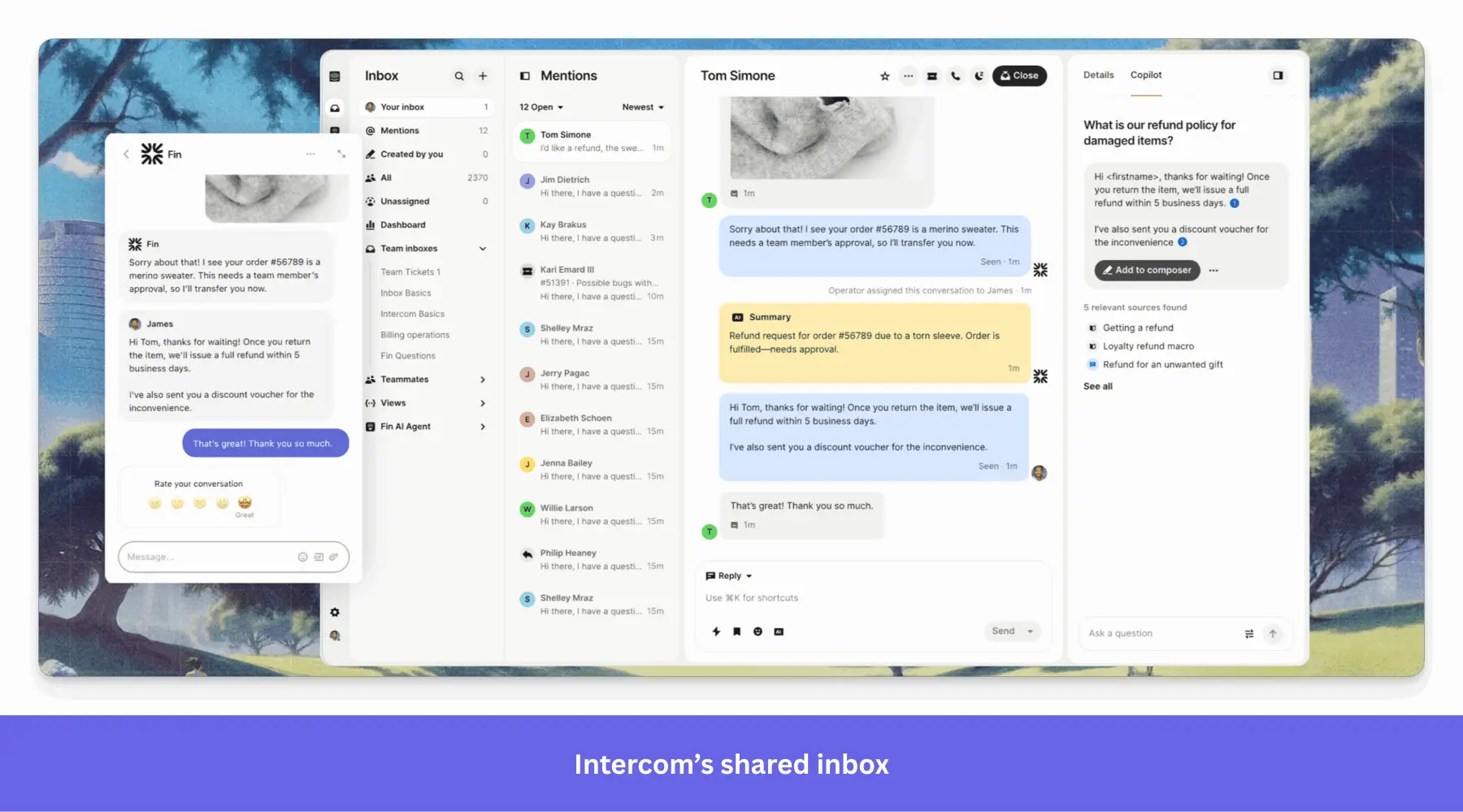
Intercom was, for a long time, the default answer when a growing company needed customer messaging software. It had the live chat widget, the help center, the product tours, the outbound campaigns, and eventually Fin - its AI chatbot powered by GPT-4. For enterprise companies with large sales teams and complex customer success workflows, it may still be the right fit. For the majority of businesses - SMBs, early-stage startups, agencies, and growing e-commerce stores - the pricing math has become very difficult to justify.
In 2026, Intercom's pricing looks like this: Essential at $29 per seat per month, Advanced at $85 per seat per month, Expert at $132 per seat per month - before add-ons. Fin AI resolutions are charged at $0.99 per resolution on top of the base plan. A five-person support team on the Essential plan with modest AI usage quickly reaches $600-$800 per month. A team on the Advanced plan with active AI resolution volume can reach $2,000-$3,000 per month. For a startup or small business already managing a tight budget, this is not a customer support tool - it is a significant business expense that demands scrutiny.
The good news is that the alternatives have improved substantially. AI chatbot technology that was exclusive to enterprise platforms two years ago is now widely available at price points that SMBs can actually afford, and in several cases at no cost at all. The five platforms below offer the core capabilities most businesses actually need from Intercom - AI chatbot, human handover, team inbox, and integrations - without the pricing that makes Intercom prohibitive for most. Three of them (Paperchat, Crisp, HubSpot Service Hub) offer a free Intercom alternative tier that is genuinely usable in production, not just a time-limited trial. Intercom itself does not have a free plan, which is part of why these searches ("free Intercom alternative", "Intercom chat free alternative", "Intercom free version") have grown so steadily.
What to Look for in an Intercom Alternative
Before examining specific platforms, the evaluation criteria matter. Businesses switching from Intercom are typically looking for some combination of the following:
- AI-powered chatbot that actually resolves customer questions, not just collects them
- Reasonable pricing for small teams that does not multiply per seat
- Knowledge base or help center for self-service support
- Human handover with a shared team inbox for escalations
- Integrations with the existing stack (CRM, e-commerce, calendar, webhooks)
The priorities vary by team type. E-commerce businesses weigh platform integrations heavily. SaaS startups prioritize AI resolution quality and the handover workflow. Agencies building for clients prioritize multi-workspace support and white-label options.
The alternatives below are evaluated across all five criteria, with honest assessments of where each platform is strong and where it falls short.
1. Paperchat
Best for: SMBs, agencies, SaaS startups, and e-commerce stores that want AI trained on their specific business content.
Paperchat takes a fundamentally different approach to AI chatbot technology than most platforms in this category. Rather than deploying a generic AI assistant that pulls from a broad knowledge base, Paperchat trains the chatbot specifically on the business's own content: uploaded documents, published URLs, written policies, and product information. The result is an AI that answers questions about your return window, your pricing tiers, your integration requirements, and your specific product capabilities - not a generic approximation of what a company like yours might say.
AI Capabilities
The core AI engine is RAG-powered (Retrieval-Augmented Generation), meaning responses are grounded in the business's actual content rather than generated from the model's general training. This dramatically reduces hallucination risk - the AI does not invent answers it does not have grounding for. It either answers from the trained content or acknowledges it cannot answer and routes to a human.
Training is designed for non-technical users. A business owner or customer success manager can paste URLs, upload PDF documentation, or write policy text directly into the platform and have a trained chatbot live within hours. No data science or AI engineering involvement required.
The AI handles clarifying conversations naturally - it can ask follow-up questions to narrow down a customer's need before delivering an answer, which significantly improves resolution quality compared to static FAQ matching.
Pricing
Paperchat's pricing is workspace-based rather than per-seat, which is the structural difference that makes it affordable for growing teams:
- Free: 100 AI credits per month - a usable free Intercom alternative for solo operators, small sites, and validation work
- Basic: $19/month - covers most small business use cases
- Pro: $49/month - full feature access including advanced integrations
- Enterprise: $99/month - priority support, extended limits
Of the platforms in this list, Paperchat's free tier is the closest thing to a true free Intercom replacement. Intercom has no $0 plan at all, only a 14-day trial. Paperchat's Free plan ships a real chatbot trained on your own content, a deployable widget, lead capture, and human handover, with no credit card required. For the five-person team scenario that costs $640-$2,960 on Intercom, Paperchat's equivalent comes to $49-$99 per month for the entire workspace. That is a 10-20x cost reduction for teams that do not need Intercom's full enterprise suite, and a 100% reduction for teams whose volume fits inside the Free plan's 100 monthly credits.
Strengths vs. Intercom
Beyond cost, Paperchat's strengths relative to Intercom center on the AI quality for domain-specific questions. Intercom's Fin AI is a capable general-purpose assistant with access to the help center. Paperchat's AI is specifically trained on content the business provides, which typically produces higher accuracy for the questions that actually arrive from real customers - questions about this specific product, this specific policy, this specific workflow.
Human handover is built in: when the AI reaches its confidence threshold, it routes the conversation to the team inbox with full conversation context preserved. The handover quality - specifically the context that transfers from AI to human agent - is an area where many platforms still fall short, and Paperchat addresses this by maintaining conversation history throughout the handover.
Integration coverage includes WooCommerce for e-commerce stores (enabling the chatbot to answer order status and product questions with live data), Cal.com for booking workflows (the chatbot can schedule appointments within the conversation), and webhook support for connecting to custom internal systems. For agencies building chatbot implementations for clients, multi-workspace management avoids the per-seat pricing problem entirely.
Limitations
Paperchat is a newer platform, and the breadth of its feature set reflects that. Intercom's outbound email campaign capability, product tours, and full customer success suite are not part of Paperchat's offering - Paperchat is focused on conversational AI chat support, not the broader lifecycle marketing stack. Businesses that rely heavily on Intercom's email sequences and outbound campaign features will find Paperchat covers only a portion of that use case.
2. Tidio
Best for: E-commerce businesses on Shopify, WooCommerce, and other major platforms wanting integrated live chat with AI assistance.
Tidio has built its market position primarily around e-commerce integration. Its Shopify native app, WooCommerce plugin, and Wix compatibility make it the default recommendation for small e-commerce businesses that want live chat plus basic automation. Lyro, Tidio's AI chatbot feature, adds conversational AI resolution on top of the live chat foundation.
AI Capabilities
Lyro uses Claude (Anthropic) to handle customer queries based on the business's FAQ content and knowledge base. The platform advertises handling up to 67% of customer queries automatically, though this benchmark comes from Tidio's own data and is achieved at favorable configurations. Real-world resolution rates for businesses with complex product catalogs or unusual return policies tend to be lower.
Lyro is an add-on, not included in base plans. Daily resolution caps apply at lower Lyro tiers - businesses with high chat volume in a single day can exhaust their daily quota, after which queries fall to human agents or standard flow-based automation. This creates unpredictable support quality on busy days (sales, product launches, holiday periods) that the base pricing does not reflect.
Flow-based chatbots are available at all plan levels and do not consume the Lyro AI resolution quota. These are rule-based conversation trees rather than LLM-powered conversations, suitable for structured interactions like lead qualification forms or order status lookups with clear branching logic.
Pricing
Tidio's pricing structure requires careful reading. The headline prices are:
- Starter: $29/month (live chat + basic automation)
- Growth: $59/month (more operators, advanced analytics)
- Lyro AI add-on: $39/month (50 resolutions/mo) to $140/month (200 resolutions/mo)
Realistic cost for a small business wanting both live chat and meaningful AI resolution capability falls at $68-$199/month depending on AI resolution volume requirements. This is still substantially cheaper than Intercom for small teams, but the total cost is less straightforward than it appears at first glance.
Strengths
Tidio's Shopify integration is among the best in the category - order lookups, product recommendations, and cart recovery flows work natively within the Tidio interface without custom development. The email marketing functionality included in higher tiers provides a lightweight campaign capability that Paperchat and Crisp do not offer. Setup is genuinely fast for standard e-commerce configurations.
Limitations
Lyro's daily resolution caps create operational unpredictability for businesses with variable traffic patterns. The add-on pricing model means AI capability is not universally available across plans - businesses on Starter get live chat and flow automation, not LLM-powered conversation. For businesses with complex product lines or policy-heavy queries, Lyro's knowledge base training is less flexible than platforms that allow direct document and URL ingestion.
3. Crisp
Best for: Startups and small teams wanting affordable multi-channel support with a solid free tier.
Crisp occupies the accessible end of the market. Its free tier provides functional two-agent live chat with no time limitation - unusual for this category, where free tiers typically expire or are severely restricted. For very small teams where budget is the binding constraint, Crisp provides more usable functionality at zero cost than most competitors.
AI Capabilities
Crisp's AI offering centers on MagicReply, an AI-assisted response tool that suggests replies to agents based on conversation context and historical interactions. This is an agent-assist model rather than a fully autonomous AI chatbot - MagicReply surfaces suggested responses that agents can accept, edit, or discard, rather than responding to customers directly without human review.
The Crisp chatbot builder is flow-based with conditional logic and scripted responses. It handles structured interactions effectively - lead qualification forms, appointment routing, FAQ trees - but does not provide the LLM-powered open-ended conversation handling that Paperchat, Tidio Lyro, or Intercom Fin offer. For businesses whose automation needs fit structured flows, this is sufficient. For businesses expecting an AI that can handle the open-ended variety of customer questions that arrive in practice, it is a notable gap.
Pricing
Crisp is one of the most affordable fully-featured platforms in this comparison:
- Free: 2 agents, unlimited contacts, basic live chat
- Pro: $25/month (4 agents, chatbot, integrations, analytics)
- Unlimited: $95/month (20 agents, all features, API access)
The $25/month Pro plan provides genuine production functionality for small teams. Unlimited messaging across all plans at the paid tier is uncommon in this category and removes a variable cost that other platforms introduce.
Strengths
The value proposition at the free and $25/month tier is hard to beat in this category. Crisp includes CRM functionality, a mobile app that the team consistently rates as one of the better mobile chat experiences, email inbox integration, and reasonable multi-channel coverage (chat, email, social messaging) for the price. For companies with limited budget and modest AI requirements, Crisp provides strong fundamentals.
Limitations
Crisp's AI is substantively less sophisticated than the LLM-powered alternatives. MagicReply is a productivity tool for agents, not a customer-facing autonomous AI. The chatbot builder creates structured flows, not conversational AI. Businesses evaluating Crisp against Intercom specifically because of Fin's AI resolution capability should understand that the AI comparison is between Crisp's agent-assist and Intercom's autonomous resolution - a meaningful functional difference. Advanced automation, complex workflow triggers, and deep CRM integration require the Unlimited tier, which at $95/month is still reasonable but is no longer the budget option.
4. HubSpot Service Hub
Best for: Businesses already running HubSpot CRM that want chatbot and support functionality integrated with their existing customer data.
HubSpot Service Hub is not primarily a chatbot platform. It is a customer service layer within HubSpot's broader CRM platform, and its chatbot functionality is most valuable to businesses already invested in the HubSpot ecosystem. For companies using HubSpot for sales and marketing, the Service Hub's chatbot connects directly to contact records, deal data, and lifecycle stage information that standalone chatbot platforms cannot access without custom integration work.
AI Capabilities
HubSpot's chatbot uses CRM context to personalize responses - the bot can reference a contact's previous purchase history, current deal stage, open support tickets, and account tier when formulating responses. For businesses with complex customer relationships where conversation context matters, this CRM-connected approach produces higher quality interactions than a chatbot with no access to the customer's history.
The AI assistance features include smart reply suggestions for agents and automatic conversation summarization. HubSpot has been expanding its AI capabilities significantly, integrating its Breeze AI toolset across the platform - though the depth of autonomous resolution capability still trails dedicated AI chatbot platforms.
Pricing
HubSpot Service Hub pricing returns to per-seat structure:
- Free: Basic live chat, limited ticketing, chatbot builder
- Starter: $15/seat/month (basic automation, email, calling)
- Professional: $90/seat/month (full automation, playbooks, SLA management, customer portal)
The free tier is functional for very small teams and worth evaluating before committing to paid. The jump from Starter ($15/seat) to Professional ($90/seat) is steep. A five-person team on Professional pays $450/month for Service Hub alone - comparable to lower Intercom tiers and similarly expensive for teams where the HubSpot ecosystem benefits do not fully materialize.
Strengths
For HubSpot-native businesses, the integration is the primary value proposition. Conversations, tickets, and contact records exist in the same system, eliminating the synchronization overhead of connecting a standalone chat platform to a separate CRM. The reporting and analytics within HubSpot are mature, and the Service Hub's playbook and SLA features serve mid-market teams that have outgrown basic chat tools.
Limitations
For businesses not already using HubSpot, onboarding the Service Hub means onboarding the HubSpot platform more broadly - which is a significant undertaking. The chatbot builder, while competent, is secondary to HubSpot's core CRM product, and its autonomous AI resolution capabilities are not the platform's primary focus. Per-seat pricing creates the same cost scaling problem as Intercom for larger teams. Businesses evaluating HubSpot purely for chatbot functionality without an existing HubSpot investment are over-buying for the use case.
5. Freshdesk Messaging (Freshchat)
Best for: Mid-size businesses wanting omnichannel customer support with AI across chat, email, and phone in a unified platform.
Freshchat, Freshdesk's messaging product, is part of the Freshworks suite - which includes help desk (Freshdesk), CRM (Freshsales), and IT service management (Freshservice). The chatbot and AI capabilities are provided through Freddy AI, which runs across the Freshworks product line and offers more mature enterprise AI features than most platforms at equivalent price points.
AI Capabilities
Freddy AI provides intent detection, automatic response suggestions, topic classification, and conversation summarization. The intent detection capability classifies incoming conversations before they reach an agent - routing billing questions to the billing queue, technical issues to the technical queue, and sales inquiries to the appropriate sales team automatically. This pre-classification reduces the agent triage time that most support teams spend at the start of each working day.
Freddy Answer Bot handles tier-1 deflection by matching incoming questions to the knowledge base and resolving common queries before they consume agent time. Resolution rates depend heavily on knowledge base quality and query type - for well-documented topics like shipping, returns, and account management, deflection rates of 30-50% are achievable in mature implementations.
The auto-resolve feature handles conversations where the customer's question was answered and no follow-up was received - automatically closing resolved conversations rather than having them age in the queue. This reduces queue length and the administrative overhead of manual conversation management.
Pricing
Freshchat uses per-agent pricing:
- Free: Up to 10 agents, basic messaging
- Growth: $23/agent/month (basic AI, routing, analytics)
- Pro: $59/agent/month (Freddy AI full features, advanced automation, SLA)
- Enterprise: $99/agent/month (custom roles, audit logs, enterprise security)
A five-person team on the Growth plan costs $115/month - accessible. The same team on Pro (where Freddy AI's full capabilities become available) costs $295/month. Enterprise-level AI features require the $99/agent tier, bringing five agents to $495/month. These numbers remain below Intercom's Advanced and Expert tiers but still scale by headcount.
Strengths
Freshchat's omnichannel coverage is among the strongest in this list - the platform handles chat, email, phone, WhatsApp, Facebook Messenger, and other channels within a single unified inbox. For businesses managing customer communication across multiple channels, this consolidation has significant operational value. The Freshworks ecosystem integration means companies using Freshdesk for ticketing get native chat-to-ticket escalation without custom configuration.
Freddy AI's intent detection and routing capability is more sophisticated than most competitors at this price point, particularly for teams that handle high inbound volume with multiple product lines or support categories.
Limitations
Setup complexity is higher than Paperchat, Tidio, or Crisp. Freshchat is built for support operations with significant workflow requirements, and configuring the routing rules, automation flows, and AI training to work well together requires meaningful setup investment. For small teams expecting to be live in a day, the learning curve is real.
Per-agent pricing means cost scales directly with team size. Businesses planning significant team growth should model the cost at projected headcount, not current headcount. The chatbot's knowledge base training is less intuitive than platforms purpose-built for AI knowledge ingestion.
Full Comparison Table
| Platform | Starting Price | AI Type | Per Seat? | Knowledge Base | Team Inbox | Human Handover | Ease of Setup |
|---|---|---|---|---|---|---|---|
| Intercom | $29/seat + $0.99/AI resolution | LLM (Fin AI) | Yes | Yes | Yes | Yes | Medium |
| Paperchat | $19/workspace | RAG (trained on your content) | No | Yes (AI-trained) | Yes | Yes | Very easy |
| Tidio | $29/mo + Lyro add-on | LLM (Lyro/Claude) | No | Yes | Yes | Yes | Easy |
| Crisp | Free / $25/mo | Agent-assist + flow bot | No | Basic | Yes | Yes | Very easy |
| HubSpot Service Hub | Free / $15/seat | CRM-integrated AI | Yes | Yes | Yes | Yes | Medium |
| Freshchat | Free / $23/agent | Freddy AI (intent + bot) | Yes | Yes | Yes | Yes | Medium-hard |
AI Quality Comparison
| Platform | AI Resolution Type | Autonomous Resolution | Context Retention | Custom Content Training |
|---|---|---|---|---|
| Intercom Fin | General LLM + help center | Yes | Good | Via help center only |
| Paperchat | RAG on business content | Yes | Yes | URLs, docs, text - direct ingestion |
| Tidio Lyro | LLM + FAQ content | Yes (with daily cap) | Good | FAQ-based |
| Crisp | Agent-assist suggestions | No (agent reviews) | Partial | No |
| HubSpot | CRM-integrated AI | Limited | CRM-connected | Via knowledge base |
| Freshchat Freddy | Intent + answer bot | Tier-1 deflection | Conversation history | Knowledge base articles |
Integration Coverage
| Platform | Shopify | WooCommerce | Calendars | Webhooks | CRM Native | API Access |
|---|---|---|---|---|---|---|
| Intercom | Yes | Third-party | Yes | Native CRM | Yes | |
| Paperchat | Via integration | Native | Cal.com native | Yes | Via webhook | Yes |
| Tidio | Native | Native | No native | Yes | Via integration | Yes |
| Crisp | Via app | Via app | No native | Yes | Basic CRM | Yes (Unlimited) |
| HubSpot | Via app | Via app | HubSpot native | Yes | Native (HubSpot) | Yes |
| Freshchat | Via app | Via app | No native | Yes | Freshsales | Yes (Pro+) |
Who Should Switch and to What
The right Intercom alternative depends primarily on why the business is leaving Intercom and what it actually uses from the platform.
Switch to Paperchat if:
- A free Intercom alternative is what you are actually looking for - Paperchat's Free plan is functional in production, not a trial
- The primary use case is AI-powered customer support and the business wants AI trained specifically on its own content
- The team is small (under 10) and per-seat pricing is making Intercom prohibitive
- Integration with WooCommerce or appointment booking (Cal.com) is a priority
- The business is an agency managing chatbots for multiple clients
- Simplicity of setup and ongoing management matters as much as feature breadth
Switch to Tidio if:
- The business is on Shopify and wants native e-commerce integration from day one
- Email marketing features alongside live chat are a priority
- The team wants a proven SMB tool with a large user community and extensive documentation
Switch to Crisp if:
- Budget is the primary constraint and a free or $25/month plan needs to cover the use case
- The team is very small (2-4 agents) with low conversation volume
- AI agent-assist is more valuable than fully autonomous chatbot resolution
- A mobile-first support experience for the team is a priority
Switch to HubSpot Service Hub if:
- The business is already using HubSpot CRM and wants to keep customer data in one system
- The chatbot needs to reference existing contact records, deal history, and lifecycle stage
- Support is part of a broader HubSpot-managed customer lifecycle, not a standalone function
Switch to Freshchat if:
- Support operations span multiple channels (chat, email, phone, social messaging) and a unified inbox is necessary
- The business is mid-market or growing toward enterprise with significant agent headcount
- Freddy AI's intent detection and routing sophistication matches the complexity of inbound volume
- The team has the setup time to configure a more feature-rich platform
The Bottom Line
Intercom built a valuable product, and for enterprises with large teams, complex sales workflows, and the budget to match, it may remain the right answer. For the majority of businesses operating outside that profile, the cost trajectory is difficult to justify when alternatives now provide comparable AI chatbot quality, human handover workflows, and integration coverage at a fraction of the price.
The businesses most likely to regret staying on Intercom are those paying primarily for AI chatbot resolution and basic live chat - use cases that are now commoditized across the alternatives above. For teams whose volume genuinely fits inside a free tier, the calculation is even simpler: Paperchat's Free plan, Crisp's free tier, and HubSpot Service Hub's free tools all qualify as a free Intercom alternative for real production use, with Paperchat being the strongest of the three on autonomous AI resolution. The businesses with the strongest case for remaining on Intercom are those who rely heavily on its outbound messaging, product tours, and deeply integrated customer success workflows that the alternatives do not replicate.
For any business evaluating a move, the practical starting point is to audit actual Intercom usage: which features are genuinely in use weekly, which are paid for but rarely accessed, and what the true per-conversation cost works out to after all charges. Most businesses that do this exercise find the utilization-to-cost ratio confirms the switch.
More Articles
How to Add a Live Chat Widget to Your Website in Under 10 Minutes
A step-by-step guide to installing Paperchat's AI chat widget on any website — no developer required.
March 29, 2026
8 Ways AI Chatbots Reduce Support Ticket Volume
A detailed breakdown of how AI chatbots cut inbound support ticket volume, with current performance benchmarks, real case studies, and practical guidance on implementation.
April 8, 2026
10 Customer Support Tasks You Can Automate with an AI Chatbot Today
A detailed breakdown of the customer support tasks AI chatbots handle best — with data, real examples, and guidance on where human agents still matter.
April 8, 2026